
Film Review: Gaia (2021)
Although the movie industry seems to have weathered COVID with relative success, there have been a few interesting side effects. Pandemic-related changes to streaming and delivery services were necessarily kicked into overdrive, as were quick adaptations of set protocols and safety measures. It’s possible – and perhaps even likely – that some of these advancements were on the horizon anyway, but their forced implementation isn’t the side effect that interests me. For that, we’ll need to look at content – specifically the recent spate of “eco-horror” films coming from the world’s wildly creative indie scenes. Gaia (from South Africa) is one such film, and while I’m sure it’s only a matter of time before Hollywood latches onto this burgeoning parabolic trend in genre horror (and inevitably waters it down, thus relieving it of any real bite), for now, Mother Nature’s revenge seems safe in the hands of inventive outsiders.
Treading similar ground to (yet remaining markedly unique from) April’s In the Earth and 2018’s Annihilation, Gaia ponders what it might look like if the forces of nature decide they’ve finally had enough of their destroyers. The film’s central concept – that the Earth is a living, breathing, even thinking entity that defends itself from an indifferent and destructive species – is not philosophically or artistically new, but when examined against the backdrop of COVID, it easily takes on a much more literal bent. In this regard, Gaia, and films like it, could be seen as “think pieces” in addition to worthy genre offerings. Whether or not Gaia gets your brain moving like it did mine is wholly dependent on how much you’d like to invest in its ideas, but director Jaco Bouwer and screenwriter Tertius Kapp make a damned compelling attempt at stirring intriguing ruminations.
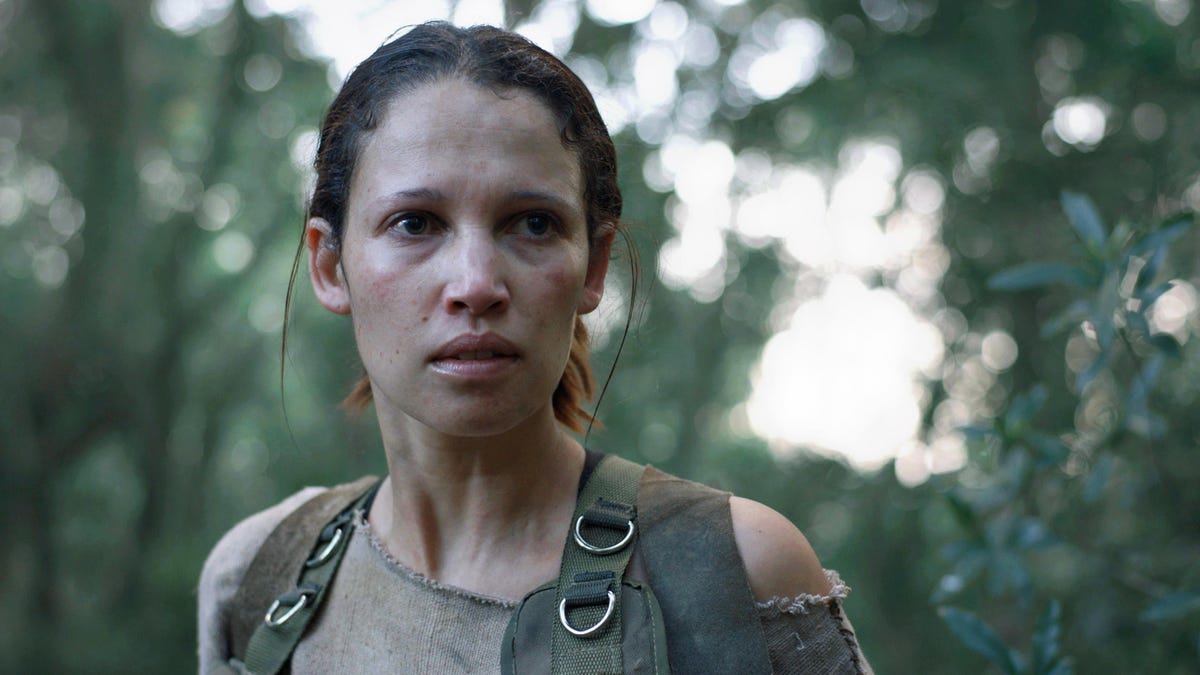
Utilizing only four identifiable human cast members (an example of those COVID-based set protocols and safety measures I mentioned), Bouwer walks us through an eerie mingling of paranoia, occultism, and grotesque mutations as we follow an injured forest ranger (Monique Rockman), her lost partner (Anthony Oseyemi), and pair of father and son hermits (Carel Nel and Alex Van Dyk) as they reconcile each other’s existence and what to do about it. The unexplored nature of Gaia‘s dense forest setting allows the creeps to settle in almost immediately (dark woods, plenty of shadows, hair-raising soundscapes, etc.), something Bouwer and his team use to full advantage whenever possible. When the creature reveal is made (surprisingly early in the film, I might add), cinematographer Jorrie van der Walt creates a nearly “found footage” feel that helps enhance the rather ominous feeling we’re witnessing something we’re not supposed to see. Couple this unease with some of the best practical effects I’ve seen in years and Gaia is taken from potentially run-of-the-mill to horrifically distinguishable.
Sadly though, where Gaia shines visually, it does somewhat lack narratively. Even at a sparse 97-minutes, Bouwer could have shaved ten to fifteen minutes off the final cut and not lost anything of importance, and in the process created a cleaner, more efficient work. Further, I’m not convinced of any of the relationship dynamics that evolve, nor am I sure how the final sequence adds much of anything to what we’ve witnessed so far. However, Gaia remains a sight to behold – especially when viewed through an environmental or COVID-influenced allegorical lens. With this in mind, its implications become even more chilling than the creatures who haunt its deep dark woods.

