
Film Review: Lonesome Dove (1989)
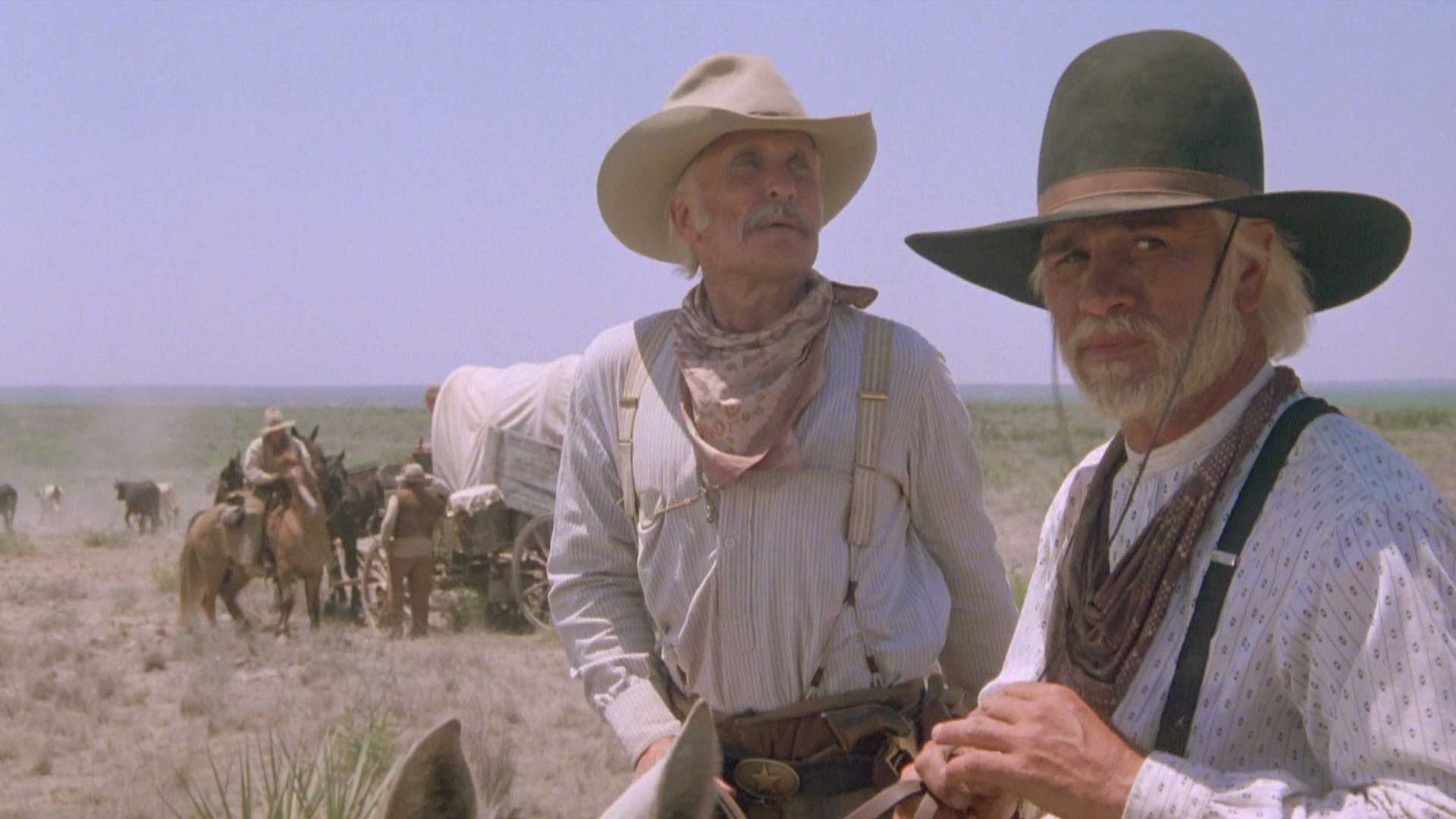
The network television miniseries may have gone out of fashion long ago, but I daresay it never fully went away. Thanks to the streaming wars, we now have what’s known as the “limited series,” but for every Midnight Mass, Chernobyl, and The Queen’s Gambit, there were first North and South, V, War and Remembrance, and, of course, Lonesome Dove. These two, three, and sometimes four-night broadcasts were huge television events, ones that brought whole families around their television sets and had people from offices to bowling alleys talking the next day.
Often adapted from dense and lengthy novels, the network miniseries had two major thorns that stuck firmly in the sides of literature buffs and fans of source material: a truncated screenplay that left out a bulk of the story and the omission or glossing over of thematically important graphic material such as sex and violence. Lonesome Dove, which aired in four parts on CBS from February 5th to 8th, 1989, is no exception to this long-standing brand of network censorship, but I’ll be damned if the TV version of Larry McMurtry’s Pulitzer Prize-winning novel still doesn’t pack a hell of a punch.
The 1985 printed version of McMurtry’s epic tale of an 1870s cattle drive from Texas to Montana is not only overflowing with triumph and tragedy (with the former often heavily influenced by the latter) but also with beautifully written observations on the violence of manifest destiny and the destruction left in its wake. McMurtry’s unapologetically grim yet intensely heartfelt examination of a wide variety of characters as they navigate both land and emotions (that is to say, their ill attempts at masking any sentiment at all) is a monumental achievement that begged for a screen adaptation. Thankfully, it only took three years for one to come along.
Helmed by veteran TV director (and sometimes Hollywood feature director) Simon Wincer, Lonesome Dove the miniseries somehow manages to preserve much of McMurtry’s sweeping Western fable, despite the inevitable interference of television censors and finite TV time. With the help of teleplay writer William Wittliff, Wincer never shies away from or alters McMurtry’s many devastating scenes but manages to tone them down enough to please the FCC while still retaining their potency. In the right hands, cleverly and effectively implying weight through the strong reactions of capable actors can take a story farther than one might think.
Even with this behind-the-scenes duo delivering on almost everything that matters, Lonesome Dove isn’t anything without its cast, which is one of the most stacked you’re likely to find anywhere before or since. A quick glance at the list includes four Oscar winners (Robert Duvall, Tommy Lee Jones, Anjelica Houston, and Chris Cooper) along with several Golden Globe and Emmy winners and nominees (Danny Glover, Diane Lane, Robert Urich, D.B. Sweeney, Ricky Schroder, Barry Corbin, William Sanderson, and even Steve Buscemi, for crying out loud).
But, when you break it all down, it’s really Jones and Duvall’s show. As former Texas Rangers Woodrow Call and Gus McCrae, these powerhouse actors perfectly bring to life the mythologized West from the perspectives of two out-of-touch men in the twilight of their usefulness. As in the book, Gus and Woodrow embody everything we’ve come to expect from the Western genre, but when filtered through a lens of modern context and a better understanding of colonialism and manifest destiny, they become tragic, broken men doing their best to hide their shame and stifle their emotions in the only ways they know how.
The pair effortlessly grabs hold of McMurtry’s revisionist subtext about masculinity and the toll it takes on those who are unquestioningly bound to it, and redirects it back at us in a way that both de-mythologizes and critiques. To pull this off with any gravity, Duvall and Jones must have known they were portraying characters who have fallen into the trap of toxic masculinity (long before such a term was used) and who suffer internally because of it. And that they know they are suffering but can’t or won’t do anything about it doesn’t make them the stoics they believe themselves to be, but rather just two more fools in a very long line of fools. And I’ll bet you real money that most modern men and boys who’ve read the book or seen the movie still wholeheartedly miss this blatant subtext completely, opting to continue bottling everything up, much to their own demise – just like Woodrow and Gus do.

