
One Punk Goes to the Movies: “Dekalog”—Krzysztof Kieślowski’s Pessimistic Critique of Morality and Sin
“There are too many things in the world which divide people, such as religion, politics, history, and nationalism…. Feelings are what link people together, because the word ‘love’ has the same meaning for everybody. Or ‘fear,’ or ‘suffering.’ We all fear the same way and the same things. And we all love in the same way. That’s why I tell about these things, because in all other things I immediately find division.” –Krzysztof Kieślowski, Oxford University, 1995
“I have one good characteristic: I’m a pessimist, so I always imagine the worst—always. To me, the future is a black hole.” –Krzysztof Kieślowski, “I’m So-So…”, 1996
In the late 1980s, Poland was on the verge of becoming Europe’s first Eastern Bloc nation to expel Soviet troops and eliminate Moscow’s influence on its politics. On the heels of this transformative shift, acclaimed director Krzysztof Kieślowski released a ten-part miniseries on Polish TV that redefined how artistry could be employed to examine personal ethics and moral dilemmas. The series was called Dekalog, an epic television event that is considered by many to be one of cinema’s finest achievements.
Kieślowski was born in Warsaw in 1941 and spent most of his life behind the Iron Curtain. After graduating from the Łódź Film School in 1968, he began making documentaries about the lives of soldiers, workers, and other ordinary Polish citizens. While these early documentaries were not intentionally or overtly political, Polish authorities and censors often took issue with how he honestly depicted the hardships of life in communist Poland.
Disillusioned with the way his documentaries were being censored or outright banned in the late 1960s and early 1970s, Kieślowski shifted his focus to narrative fiction to avoid further censorship while still maintaining his signature sense of social realism. It was during this period that the loosely formed but influential “Cinema of Moral Anxiety” movement began to take shape in Poland, with internationally respected filmmakers like Agnieszka Holland and Andrzej Wajda, along with Kieślowski, leading the charge. Kieślowski’s 1979 film Camera Buff is often considered the defining film of the Moral Anxiety movement, while his 1981 film Blind Chance wouldn’t be seen until 1987, when it was finally deemed acceptable for audiences, albeit highly edited and censored.
As with Kieślowski’s prior documentary work, the films he made under the Cinema of Moral Anxiety banner contained no straightforward political messaging but simply portrayed Polish life as it was for the working class. However, the dreariness of these films and the depressed state of the characters depicted in them were more than sufficient to convince Polish authorities that Kieślowski and his cinematic compatriots were intentionally criticizing the government and its policies. The movement was formally disbanded in 1981 when Poland declared martial law to suppress opposition to the Polish People’s Republic under General Wojciech Jaruzelski.
When martial law was finally lifted two years later, Kieślowski resumed where he left off: with the release of 1985’s No End (about life under military rule, the director’s first distinctly political narrative film, and his first collaboration with screenwriter Krzysztof Piesiewicz) and the eventual 1987 release of Blind Chance, which had been completed in 1981 but left to rot on the censorship bureau’s shelf for six years. It was also during this time that Kieślowski and Piesiewicz began to form the ideas for what would become one of cinema’s most celebrated works.
Originally, the ten-part project that would become Dekalog was to have a different director for each installment, but as Kieślowski and Piesiewicz trudged forward with development, it was decided that Kieślowski would direct all ten episodes. Nine different cinematographers were hired (Piotr Sobociński, who would go on to be nominated for an Academy Award for Kieślowski’s film Three Colours: Red in 1994 directed two episodes), and a large cast was assembled to tackle the immense undertaking.
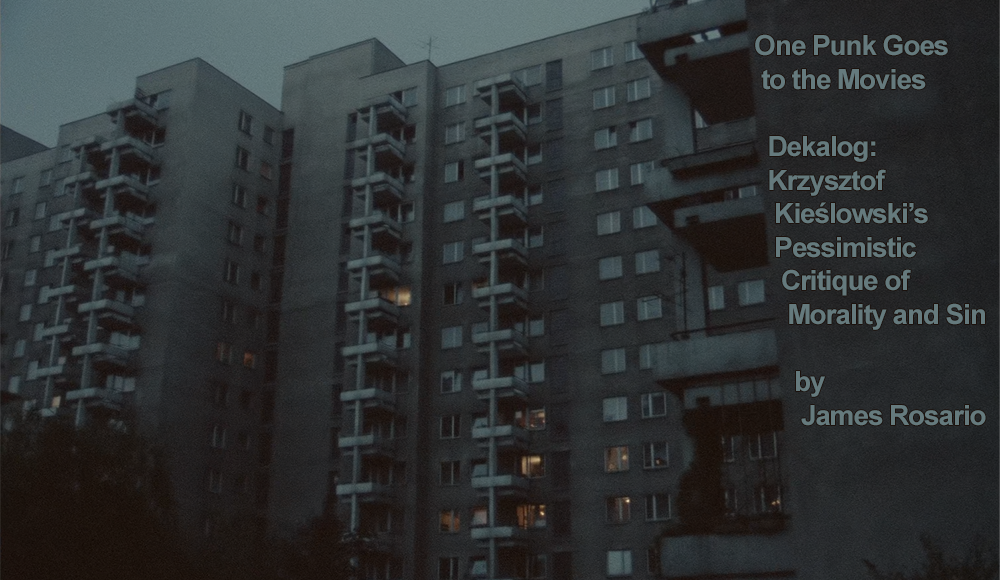
Debuting at the Cannes Film Festival in May 1989, and on Polish television later that year, Dekalog told ten loosely interconnected stories centered around the occupants of a housing project in Warsaw. While not blatantly religious, each episode of Dekalog addresses ethical and moral dilemmas associated with the Ten Commandments, but does so without ever plainly referencing them in any way. Kieślowski was interested in the choices people made under difficult circumstances, not their religious reasons for doing so.
Interestingly, and despite its rather cynical and fatalistic view of Christianity, Dekalog is one of only fifteen titles included in the Vatican’s shortlist of films that exemplify the meaning of “values.” Other films on the list include Gandhi (1982), Intolerance (1916), Au Revoir, Les Enfants (1987), Dersu Uzala (1974), The Tree of the Wooden Clogs (1978), Rome, Open City (1946), Wild Strawberries (1957), The Seventh Seal (1957), Chariots of Fire (1981), The Bicycle Thief (1948), It’s a Wonderful Life (1946), Schindler’s List (1993), On the Waterfront (1954), and The Burmese Harp (1956).
What follows is a short synopsis and analysis of each episode and how Kieślowski uses the Ten Commandments to examine human behavior. The quoted commandments are taken from the upper-Midwest Lutheran upbringing I abandoned in the early-’90s when my youth pastor said I couldn’t listen to heavy metal and punk anymore. (Fuck that guy.)
Dekalog One: “Thou shalt have no other gods before me…”
Kieślowski begins his series with a heartbreaking and prophetic vision of how reliance on technology can quickly replace human interaction and logical thinking. As a young boy searches for answers about his estranged mother using his father’s personal computer, he becomes obsessed with life’s meaning. While Dekalog One is by no means an “anti-technology” think piece, it nonetheless argues that computers and computer models can’t predict all of life’s variables and that they certainly can never be an adequate substitute for real-life companionship, and by extension, anything resembling a “soul.”
Dekalog Two: “Thou shalt not take the name of the Lord thy God in vain.”
Episode two follows an angry woman named Dorota who corners and harasses a doctor, insisting that he diagnose her sick husband. The reason for her insistence is that she’s pregnant by another man and has decided that, if her husband dies, she’ll keep the baby. But if he lives, she’ll abort it. By choosing to keep something so important from her husband, her words carry an enormous amount of weight. Likewise, so does the doctor’s, as his own sense of morality interferes with Dorota’s plan. God is nowhere to be seen, but what one chooses to say or not say, and to whom they say it, is of grave importance.
Dekalog Three: “Remember the sabbath day, to keep it holy…”
On Christmas Eve, a lonely woman attempts to rekindle the affair she had three years earlier. Through trickery and guilt, she manages to keep her ex-lover away from his family all night in a vain attempt to ease her loneliness and regret. While the Christmas holiday is certainly an important night for much of the world, Kieślowski doesn’t use it here in a religious context but rather a nostalgic one. For many, significant days hold meaning and serve as a reminder of loss or sorrow. Thus, they become “holy” outside of traditional theological reverence and take on new personal meanings for those who feel lost and alone.
Dekalog Four: “Honor thy father and thy mother…”
Perhaps the most uncomfortable of all ten episodes, Dekalog Four involves a single father and his young adult daughter who discover a secret they both suspected was true. Up to this point in the series, the ethical paths forged by Kieślowski have been relatable on at least some level. We may not have experienced such things literally, but they still resonate because it isn’t difficult to imagine the emotional baggage each character carries. But Dekalog Four strays from Kieślowski’s established formula into something thoroughly awkward. It begins, as most episodes do, with decent people trying the best they can, who are eventually presented with a dilemma of some kind. This dilemma, though, is not just an ethical one, but one based on the kind of societal distaste you’ll recognize the moment it’s hinted at. But because Kieślowski knows how this story will make us feel, perhaps therein lies part of his genius: flawed people come in all kinds, and maybe we’re not supposed to feel good about their “victories.” In this way, it may also serve as a primer to the most infamous episode of the entire series, Dekalog Five.
Dekalog Five: “Thou shalt not kill…”
Up to this point, Kieślowski has avoided direct political commentary in favor of a more abstract examination of ethical dilemmas, but Dekalog Five is different. What begins as seemingly disparate stories of three ordinary men—a drifter, a taxi driver, and a lawyer—converges on a brutally violent act committed by an individual and gives way to another equally violent act committed by the state. Kieslowski doesn’t mince words about his condemnation of the death penalty, but neither does he shy away from the condemned man’s obvious guilt. Dekalog Five can be hard to watch, but in its harshness lies a genuine plea for compassion rarely executed on film with such virtuosity. Dekalog Five was expanded into a feature-length film called A Short Film about Killing, and, along with A Short Film about Love (expanded from Dekalog Six) was screened at the 1988 Cannes Film Festival.
Dekalog Six: “Thou shalt not commit adultery…”
Kieślowski’s decision to title the extended feature-length version of the sixth entry in his series A Short Film about Love is an interesting choice, as love in the traditional sense is exactly what escapes its main characters. Tomek is a confused nineteen-year-old peeping tom who, through trickery and deceit, manages to meet Magda, an older thirty-something woman living in the apartment across the courtyard. By modern standards, Tomek would likely be labeled an incel or a pervert, but Magda is intrigued by him and takes a certain amount of pleasure in his obsession. However, rather than condemning both for their somewhat antisocial behavior, Kieślowski instead examines how each has a skewed vision of what love means and how it affects their actions. Tomek and Magda may be dysfunctional, but neither is particularly mean-spirited. Kieślowskii compassionately allows them to grow past their shortcomings and become more than they once were.
Dekalog Seven: “Thou shalt not steal…”
On its surface, Dekalog Seven may appear to fit better with “Honor thy father and thy mother” than it does with “Thou shalt not steal,” but consider that theft can extend beyond what one might usually regard as traditional property. Hidden somewhere within this rather complicated exterior—about a scandalized grandmother (Ewa) raising a six-year-old girl (Ania) as her own, much to the resentment the child’s actual mother (Majka, Ewa’s daughter) who’s forced to pretend to be the child’s older sister—lies the episode’s true meaning: both Ewa and Majka have stolen Ania’s innocence by using her as a tragic pawn in their psychological war with each other. It’s implied that this theft is something Ania can never recover from, making the climax of Dekalog Seven one of the best of the series, despite the somewhat messy road it takes to get there.
Dekalog Eight: “Thou shalt not bear false witness against thy neighbor…”
Often considered one of Dekalog’s strongest entries, Eight tackles Catholic guilt with a gusto as a Holocaust survivor confronts the woman who refused to help her during the war. However, true to Kieślowski’s well-established compassion for his characters and their plights, Dekalog Eight is not necessarily an indictment of regrettable past behavior but rather a study of how dire circumstances bring people together and force decisions that go against one’s moral code. Kieślowski is asking us to decide if lying to save yourself or your family—even at the risk of someone else’s safety—is an inherently immoral act, and if so, can one be forgiven for it? Most importantly, though, he reminds us of the power of truth and how we can’t escape the consequences when we willfully ignore it or make excuses for it.
Dekalog Nine: “Thou shalt not covet thy neighbor’s wife…”
With Nine, Kieślowski could have taken the obvious approach and told a matter-of-fact story about adultery and jealousy, but that wouldn’t be his style at all. Instead, he focuses on a “broken” man named Roman who loves his wife, Hanka, dearly but gives her permission to cheat due to his inability to express his love physically. However, Hanka truly loves Roman back, and even though she eventually has an affair, she almost instantly regrets it. Things become complicated, and perhaps even a bit creepy, when Roman begins to suspect Hanka of infidelity, but it’s their lack of openness and honesty that truly drives things off the rails. What’s interesting is that instead of focusing on the man doing the coveting, Kieślowski chooses to concentrate on the husband of the woman coveted—and then refrains from denouncing or demonizing anyone involved.
Dekalog Ten: “Thou shalt not covet thy neighbor’s house…”
The final installment in the Dekalog series is unique in that, instead of a dour exploration of humanity’s failings, Kieślowski gives us a rather funny black comedy. He also introduces us to a punk band called City Death, indicating that the aging director was at least marginally clued-in to what the underground youth of Poland were up to at the time. Ten centers on two brothers who inherit a valuable stamp collection from their father and how they go about completing it and protecting it. At its heart, it’s a well-structured “comedy of errors” full of unscrupulous stamp collectors, laughable coincidences, poor decisions, and human organ theft (you heard me), but mostly it serves as a well-earned respite from the weighty subject matter of the previous nine hours. It may not be profound, but it’s funny as hell and a fantastic way to end one hell of a series.
Originally published by RAZORCAKE.
Poland • 1988 • 583 minutes • Color • 1.33:1 • Polish • Spine #837
Criterion Special Features Include
- New, restored 4K digital transfers of all twelve films, with uncompressed monaural soundtracks
- Selection of archival interviews with director Krzysztof Kieślowski, taken from a 1987 television piece on the production of Dekalog: Two, excerpts from the 1995 documentary A Short Film About “Dekalog,” and a 1990 audio recording from the National Film Theatre in London
- New program on the formal and thematic patterns of Dekalog by film studies professor Annette Insdorf
- New and archival interviews with Dekalog cast and crew, including cowriter Krzysztof Piesiewicz, thirteen actors, three cinematographers, editor Ewa Smal, and Kieślowski confidante Hanna Krall
- Trailers
- PLUS: A book featuring an essay and capsules on the films by cinema scholar Paul Coates, along with excerpts from Kieślowski on Kieślowski
