
Film Review: The Old Oak (2024)
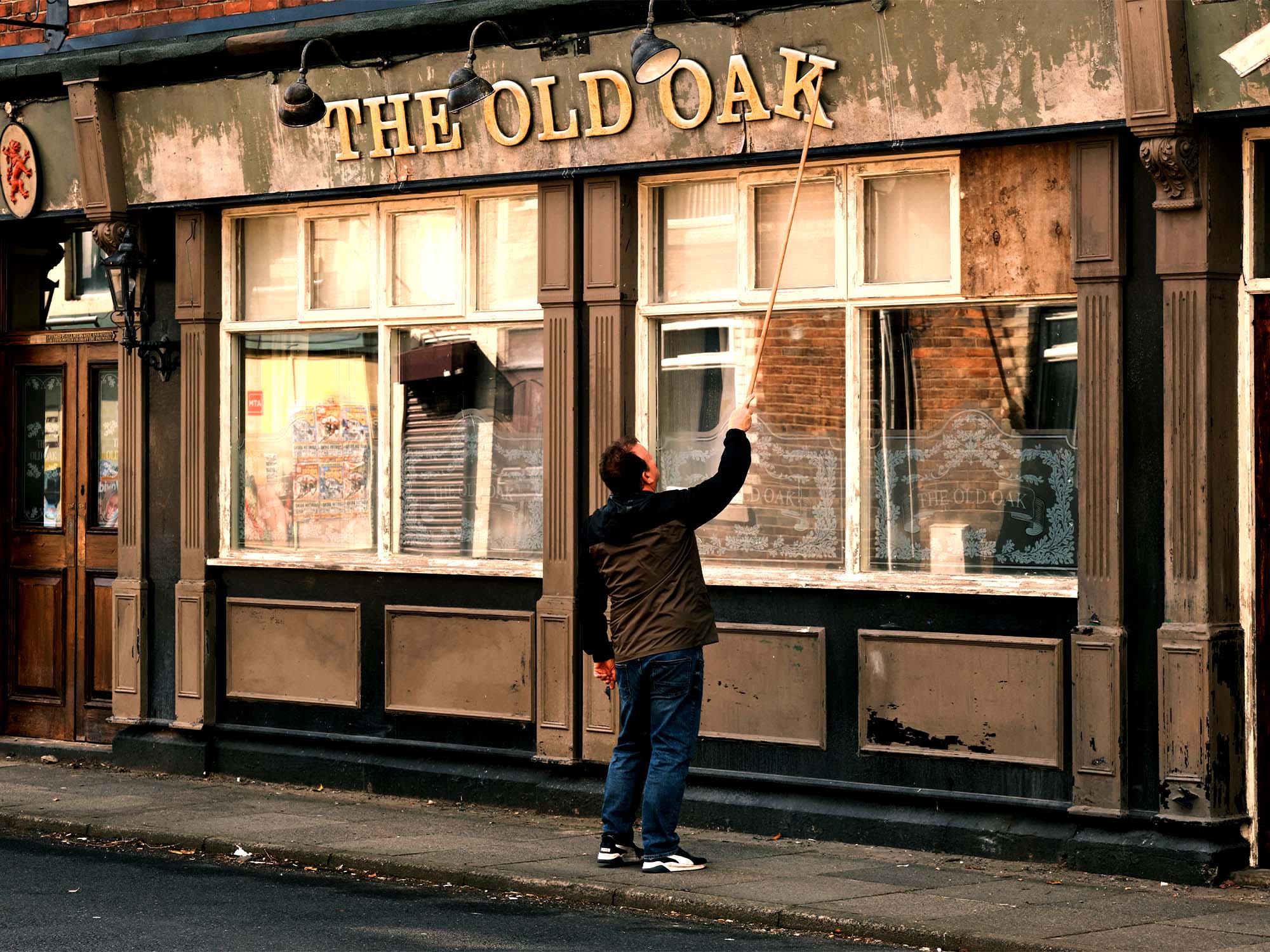
English director Ken Loach has had a long and successful career as an understated rabble-rouser. A constant thorn in the side of British censors and those who would exploit or take advantage of the working people everywhere, Loach has never sugarcoated his socialist values nor shied away from controversy. His films, which often examine and celebrate the lives of England’s economic underclass – the workers, the immigrants, and the forgotten – are a masterclass in character development and the relationships that form between struggling people.
The Old Oak, the veteran director’s newest (and rumored final) film, carries on this tradition by offering an insightful look at a single neighborhood in County Durham rocked by misplaced anger and generations-old prejudice. And true to form, you can bet that Loach will grab onto your heartstrings and pull with all his might, possibly for the last time.
Narratively speaking, The Old Oak is not a complicated film, but Loach has a way of taking this rather simple story of a district in decline and injecting it with so much humanity that it feels as if it will burst at the seams at any moment. Ostensibly the story of how aggrieved residents react to a wave of Syrian refugees moving into the increasingly vacant houses on their street, The Old Oak is much more than a familiar tale of intolerance. At every turn, Loach is careful not to paint his townspeople as outright racists, but instead as fed-up working-class folks who haven’t quite figured out that the outrage welling up inside them is aimed entirely at the wrong target.
Told through the budding friendship between pub owner TJ (a fantastically nuanced and emotional Dave Turner) and Yara, the straightforward de facto spokesperson of the growing refugee population (played with purpose by Ebla Mari), The Old Oak continuously surprises with tender turns of growth and realization. When tensions begin to mount, TJ refuses some of the louder locals (some of whom he’s known since childhood) the use using his pub to have a meeting about the refugee “problem,” and a well-defined rift begins to form in the once-prosperous mining town. Things escalate when TJ instead opens his pub for use as a place to feed the neighborhood’s hungry children, many of whom are impoverished lifelong residents.
What’s interesting, and what Loach so expertly conveys, is that those most irked by TJ’s perceived betrayal seemingly have no concept that the slump their lives and incomes have been in began long before a single refugee showed up. Instead of blaming the real culprits for the mine closures that led to the decline in wages, property values, and quality of life (i.e., the capitalist mine owners and landlords whose unsustainable profit motive outweighs any sense of human dignity), they blame the newcomers.
But this is largely a ruse on their part, and an excuse for heated vitriol. The truth is that the outraged locals aren’t stupid. They know exactly who’s to blame for their situation – they’re just afraid to admit that they were duped and that the company they gave their lives to abandoned them the moment they were no longer profitable. It’s this unspoken realization that, more than anything, drives The Old Oak: sometimes it’s just easier to hate than to acknowledge you’ve been played the fool or that your “traditional” values are no longer acceptable.
Through a series of generous acts of kindness, as well as ones of pure spite, Loach offers us a glimpse of forgiveness and understanding that mainstream cinema often has trouble conveying with any real sense of accuracy or feeling. The Old Oak is full of big emotions – good and bad alike – but ultimately it’s the people’s compassion towards one another that wins the day. Once again, Loach proves that he is a true ally of the working class and a sincerely principled artist. If only more directors would have the courage to live up to the high standards he sets, moviedom could have a much bigger upward punch.

