
Film Review: Bicycle Thieves (1948)
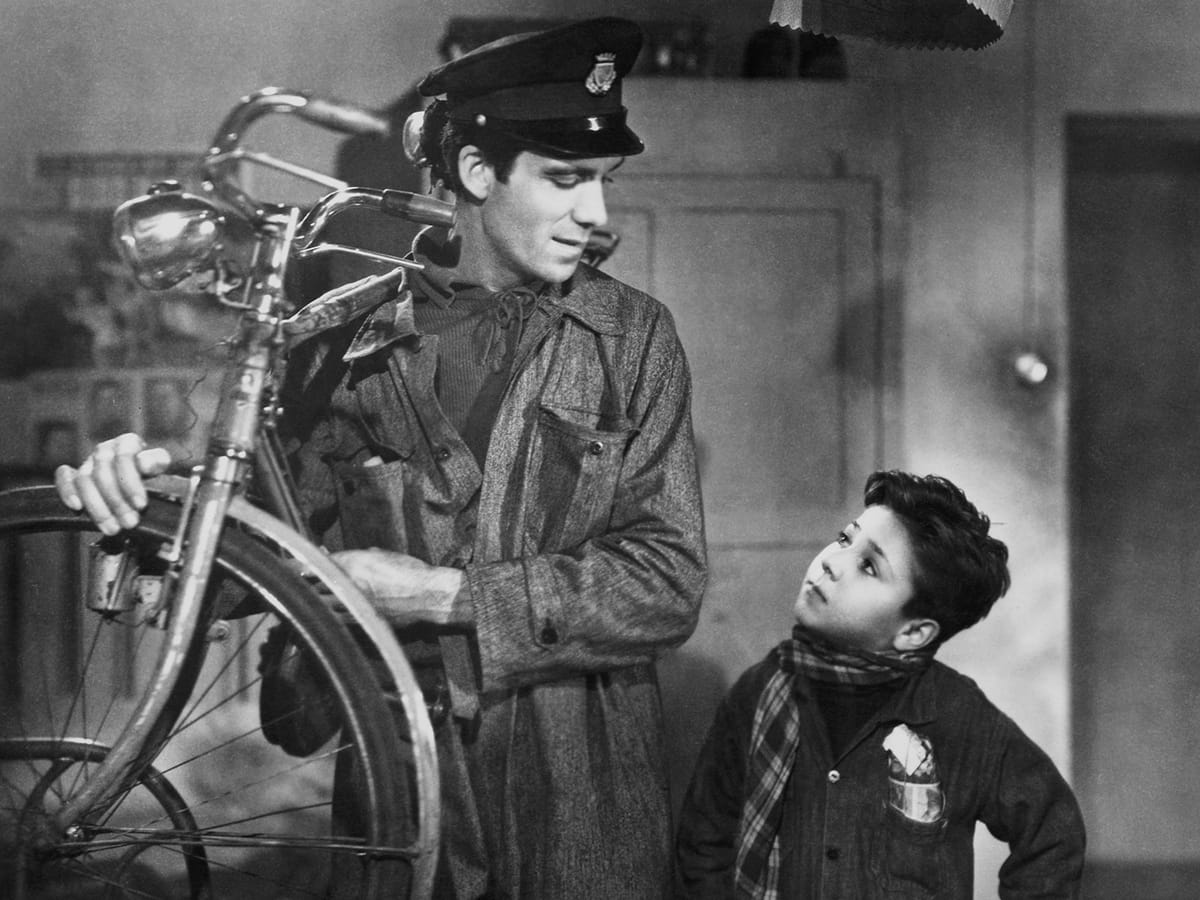
Vittorio De Sica’s Bicycle Thieves may be a grim look at poverty and desperation in post-war Rome, but it’s also an ode to the determinism found in Italy’s working class in the years following Mussolini’s fascist reign. As the film’s title suggests, unfortunate times can lead many to act outside the law, but what De Sica artfully demonstrates is that, even among the worst of us, there still exists a wealth of humanity and sacrifice that can’t be measured in Italian lira. But, perhaps more importantly, we learn that even among the best of us, the opposite is also true.
The film’s protagonist, Antonio (Lamberto Maggiorani), is, by all accounts, a decent man. He loves his wife Maria (Lianella Carell) and son Bruno (Enzo Staiola) and strives every day to provide for them. When an opportunity for steady employment presents itself, he jumps at the chance, despite having to tell a white lie to secure the job. His pride is evident, and his wife shares in his newfound fortune by pawning her expensive linens to get him the thing he needs most for his new gig as a poster hanger: a bicycle.
So far, Bicycle Thieves is brimming with optimism and exhilaration, but of course it’s not going to last. For every honest and good-natured Antonio of De Sica’s Rome, there are plenty of heels and perhaps even more who are indifferent to the actions of heels. Antonio learns this the hard way, and it eats him up inside.
De Sica’s Rome, though, is far from a stylized or romanticized version of past events or an exaggerated remembrance of tough times come and gone. In the late ‘40s, it was a city trying its damndest to redefine its identity in the wake of World War II and to find its economic and cultural footing on the world stage. De Sica and his neorealist contemporaries would be a driving force in that struggle.
In an effort to depict Rome as it was then and not as it was fondly remembered on postcards and paintings, the city seen in the film is the same one that De Sica lived in. It wasn’t a pretty place to look at, nor was it necessarily a nice one to live in either. Hardships were many, and those seen in film were largely the same as those suffered by his actors. In fact, most of his cast had never been in front of a camera before their work on Bicycle Thieves. Lamberto was a factory worker, for example, and Staiola was a scrappy kid who, by design, De Sica discovered and molded into a pure work of art.
And it’s this non-professionalism, along with Rome’s defeated-looking streets and boisterous air of a nation newly freed, that gives Bicycle Thieves such an edge over its competitors abroad. What De Sica has crafted is a very real film, made more so by the pure nature of its often depressing reality. In the Italian neorealist tradition, Bicycle Thieves rightfully stands in front of them all, not because of landmarks or whimsical jaunts through a historical city, but because of the relatable futility of a central conflict taking place among a disillusioned populace striving to survive in a shell of a once-glorious country.
Sadly, as late-stage capitalism and neoliberalism continue to wheeze out their dying breaths, Bicycle Thieves is likely a much more poignant film for Millennial and Gen Z viewers than for their Boomer counterparts. Like Rome in the late ’40s, 21st century Americans have learned to go without, and that’s not how things are supposed to work. Sadly, just as Antonio’s search for his stolen bicycle will never result in its return, so too can a young person’s dreams of home ownership result in an affordable mortgage. What is going on here?
With Antonio’s recently won pride now eroded to almost nothing, he is desperate to win it back, even if it means betraying everything that makes him the decent man that he is. His despair is palpable, which begs the question: how badly would you injure your own pride in exchange for basic security? And how much blame can you cast on others for doing the same?

Italy • 1948 • 89 minutes • Black & White • 1.37:1 • Italian • Spine #374
Criterion Special Features Include
- New 4K digital restoration with uncompressed monaural soundtrack
- Working with De Sica, a collection of interviews with screenwriter Suso Cecchi d’Amico, actor Enzo Staiola, and film scholar Callisto Cosulich
- Life as It Is, a program on the history of Italian neorealism, featuring scholar Mark Shiel
- Documentary from 2003 on screenwriter and longtime Vittorio De Sica collaborator Cesare Zavattini, directed by Carlo Lizzani
- Optional English-dubbed soundtrack
- PLUS: An essay by critic Godfrey Cheshire and reminiscences by De Sica and his collaborators
