
Film Review: Green Book (2018)
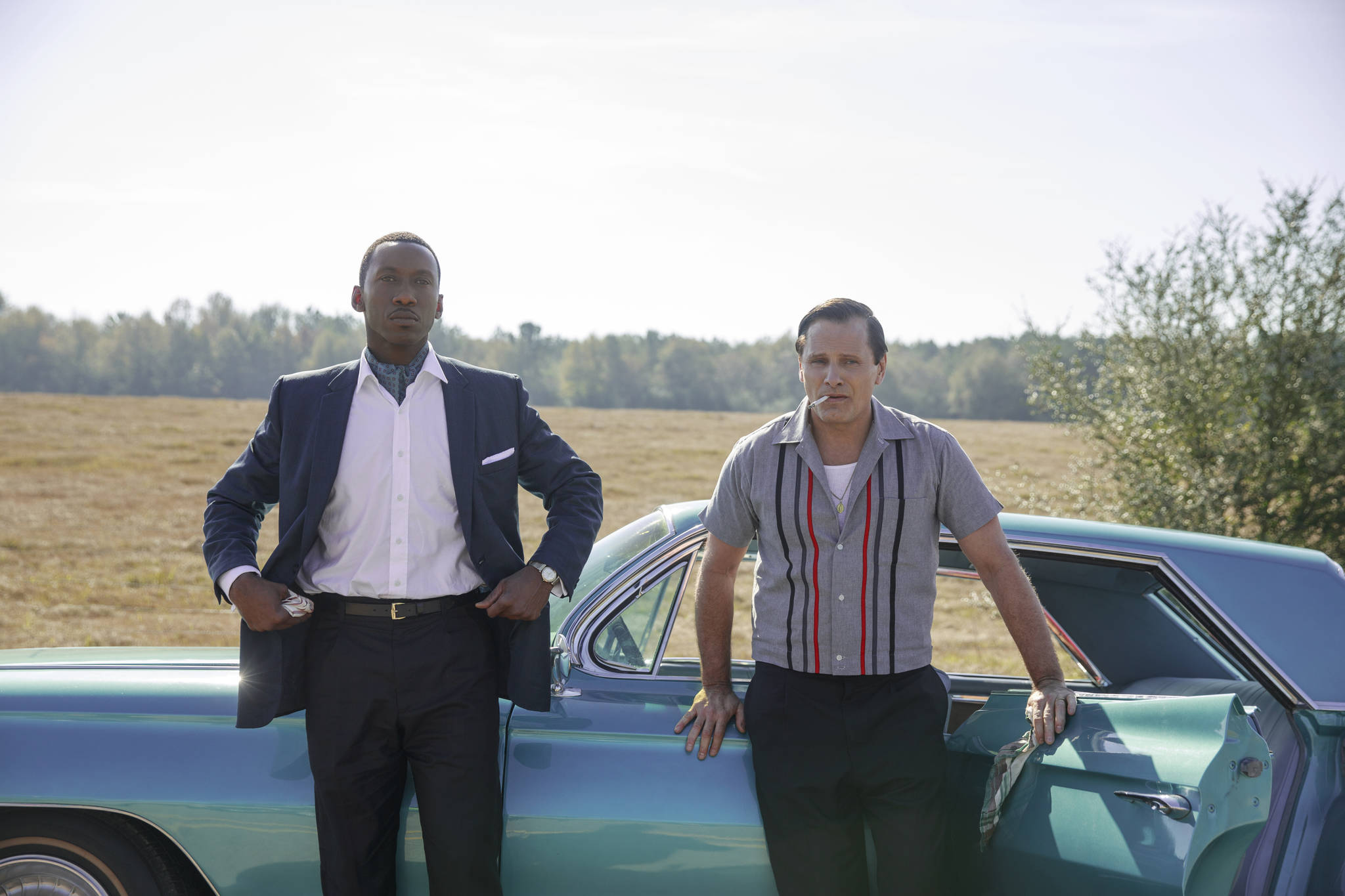
Traditionally in Hollywood, societal ills like racism are easily solved by a white person mustering up the courage to acknowledge a person of color’s dignity and/or existence. We’ve seen it time and again, and it never fails to elicit congratulatory pats on the back and ham-fisted handshakes signifying that once again, we can put the nasty business of racism to bed. Too bad the only thing this approach ever really manages is making white folks feel better about themselves. I get what Green Book thinks it’s accomplishing – it just doesn’t do a very good job of accomplishing it.
The term “false equivalence” kept jumping into my head while watching Peter Farrelly’s movie. You see, in Green Book, you have two men: one white, one black. The white one, Frank “Tony Lip” Vallelonga (Viggo Mortensen) is a New York bouncer with all the racial sensitivity that one can imagine a 1960s bottom-rung mob guy might have. The black one, Don “Doc” Shirley (Mahershala Ali) is an uptight pianist about to embark on a tour of the Deep South who needs a driver and bodyguard. Along the way, Doc breaks down Tony’s prejudices, while Tony teaches Doc how to let loose a bit. Herein lies the problem. Farrelly wants us to see these two feats as equally important. One man cures another’s inherent and deep-seated racism, while the other learns how to relax and live a little. See the disparity?
Adding to that, the very real threat of violence and the state of perpetual trepidation black folk have endured for centuries is quickly glossed over in Farrelly’s version of the Jim Crow south. All instances of Doc facing a racist white person is solved in a matter of minutes by an intervening Tony, usually with some sort of moral comeuppance for the “Well I never…”-faced white offender. It’s dishonest to gloss over the terror most people of color felt during this time in favor of feel-good white savior-hood. The indexable racist crackers taking violent actions or systematic potshots at one of the finest piano players to have ever lived is a story worth telling, but to do so correctly and honestly means taking a good hard look at racism itself – not just the easily identifiable boogeymen we’ve been trained to identify. And Tony’s racism? No need to mention that – it magically vanishes.
That’s not to say that Green Book doesn’t have some good qualities. Ali is nothing short of wonderful as the eccentric and guarded Shirley. There’s a ferocity and a fear lurking simultaneously within the character that Ali never betrays. Mortensen isn’t bad either, but Tony is never challenged fundamentally in the way that Doc is which makes him immediately less interesting. Doc has systematic racism (and homophobia) to deal with, Tony has letters to his wife (there’s that false equivalency again). Their chemistry is good, though, and the film is at times very funny, but none of it is enough to save it from its melodramatic portrayal of race relations. With some changes of focus and approach, Green Book could have been an important film. Instead, it’s a feel-good, shallow caricature of what white people think racism in America is.

