
Film Review: Columbus (2017)
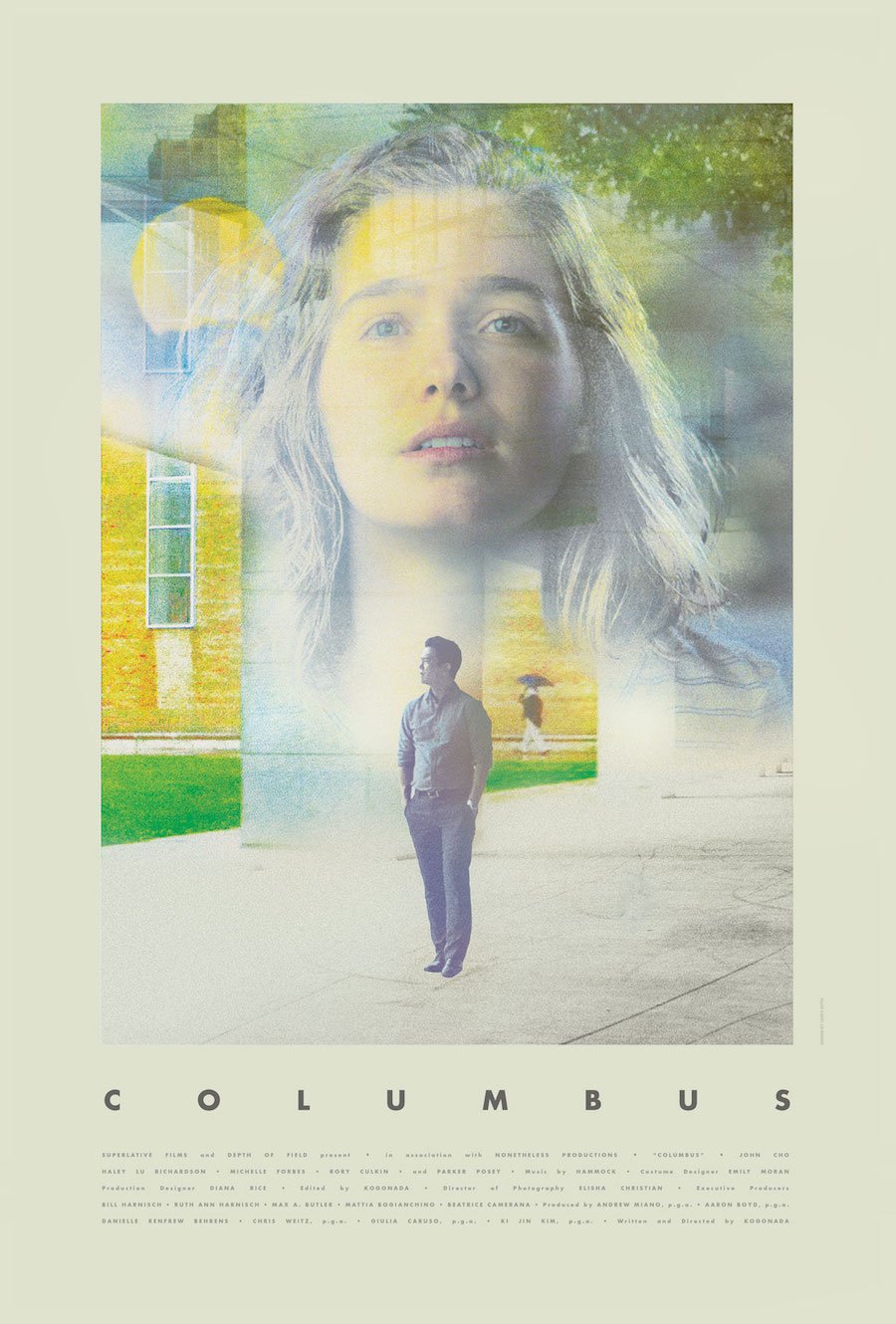

In his feature film debut, Kogonada has really captured something special. Columbus is a wonderful film, and a joy to behold. It’s packed with just the right amount of arthouse sensibility, stunning visuals, measured cinematography, and compelling characters that, by the end of it, you know you’ve seen something very real. You can feel it.

It’s a very refreshing film as well. There are plenty of possibilities for it to fall on any number of tropes, but it never does. The friendship between the two leads is just that, a friendship. In a lesser film, you would expect them to develop a romance and sleep together, which would have complicated things just the right amount for it all to be resolved in the third act. No such luck, and what a relief. Everyone is allowed to be themselves, unfettered by romantic complications. If this were another film, the growth that each character experiences would be lost within the “love” angle. It would have been another banal romance film. How boring.

John Cho plays Jin, a Korean-American translator living in Korea. When his famous architect father suffers a stroke in Columbus, Indiana while on a book tour, Jin travels to see him. Haley Lu Richardson is Casey, a local Columbus girl with a love for architecture and a recovering addict mother who she takes care of. Columbus (and this was news to me) is somewhat of an architectural mecca. In the 50s and 60s, a number of structures were built there in the Modernist style, making it a place for study and tourism. Jin knows a bit about architecture, but is largely uninterested—or at least pretends to be. Casey is fascinated with it and shows a lot of promise in the field.

The two meet by chance and become fast friends. They find solace in each other’s company (Jin speaks of his father, Casey, reluctantly, about her mother and the town she loves). It’s these conversations (written by the director)— often taking place with stunning Modernist structures in the background—where the film really lives. It’s rare that a film can truly reveal a character just through lighthearted, casual, and at times, quite heavy conversations, but Jin and Casey come alive in these moments in ways that you just don’t see very often.

There are peripheral characters that help us get to know our main characters as well. On Jin’s side, there’s Eleanor (Parker Posey), his father’s assistant and the object of a youthful crush. Casey has her recovering mother (Michelle Forbes), and her bookish coworker, Gabriel (Rory Culkin). An extra layer of depth is added with each scene, regardless of who is in it. There are no wasted words, and no wasted time, even though there are long moments of silence.

This depth of character is augmented by the sheer beauty of the city and the structures in which it takes place. Long shots and symmetry are common (thanks to cinematographer Elisha Christian), giving the film a very Kubrickian feel. Dialogue sometimes takes place completely off-screen, allowing for the study of the listener’s face. And there’s something else that struck me: you can almost always hear street traffic in the background. Why do you suppose this is? Casey says that almost nobody that lives in Columbus notices or cares about the beauty there. Jin, who grew up with a famous architect, says that if you’re raised around something, it becomes normal. Could the traffic represent the rest of the world never stopping to notice, ceaselessly moving, with no time to appreciate art or beauty? You tell me.

Columbus is a beauty of a film. It’s rich both visually and emotionally, acted superbly, and has no use for the usual traps that could have easily turned it into a sentimental tearjerker, or worse, a typical, run-of-the-mill romance. A very fine debut.
