
Film Review: Moonlight (2016)

Recently I published a Top 10 Films of 2016 list. In the forward to that list, I pointed out that I hadn’t been able to see all of the films that I wanted to see (naturally, you can’t see everything). I singled out Moonlight as my most regrettable miss of the year. I had read several reviews and just knew that I was missing out on something special. Well, I finally was able to see it, and I most certainly was missing out on something special. Not only do I feel that Moonlight is a serious contender for the best picture Oscar if you’re one to place value on that sort of thing, but I hope it wins for a number of reasons. The struggle for identity is the core of the film, but along the way we are subjected to a treatment of accepted roles within societal norms, and how our environment shapes us, changes us, and often forces us to fit into roles we aren’t quite comfortable with.
The recognition director Barry Jenkins and cinematographer James Laxton are receiving is beyond deserved (both are nominated for Academy Awards for their efforts). These men are not afraid of camera movement. They employ long takes and plenty of handhelds, but they are also reserved when needed. The many static shots are haunting, and play as a stark contrast to the chaos of the main character’s life. These moments of camera calm, however, seethe with heavy emotion boiling to the surface. It is very nearly flawlessly executed.

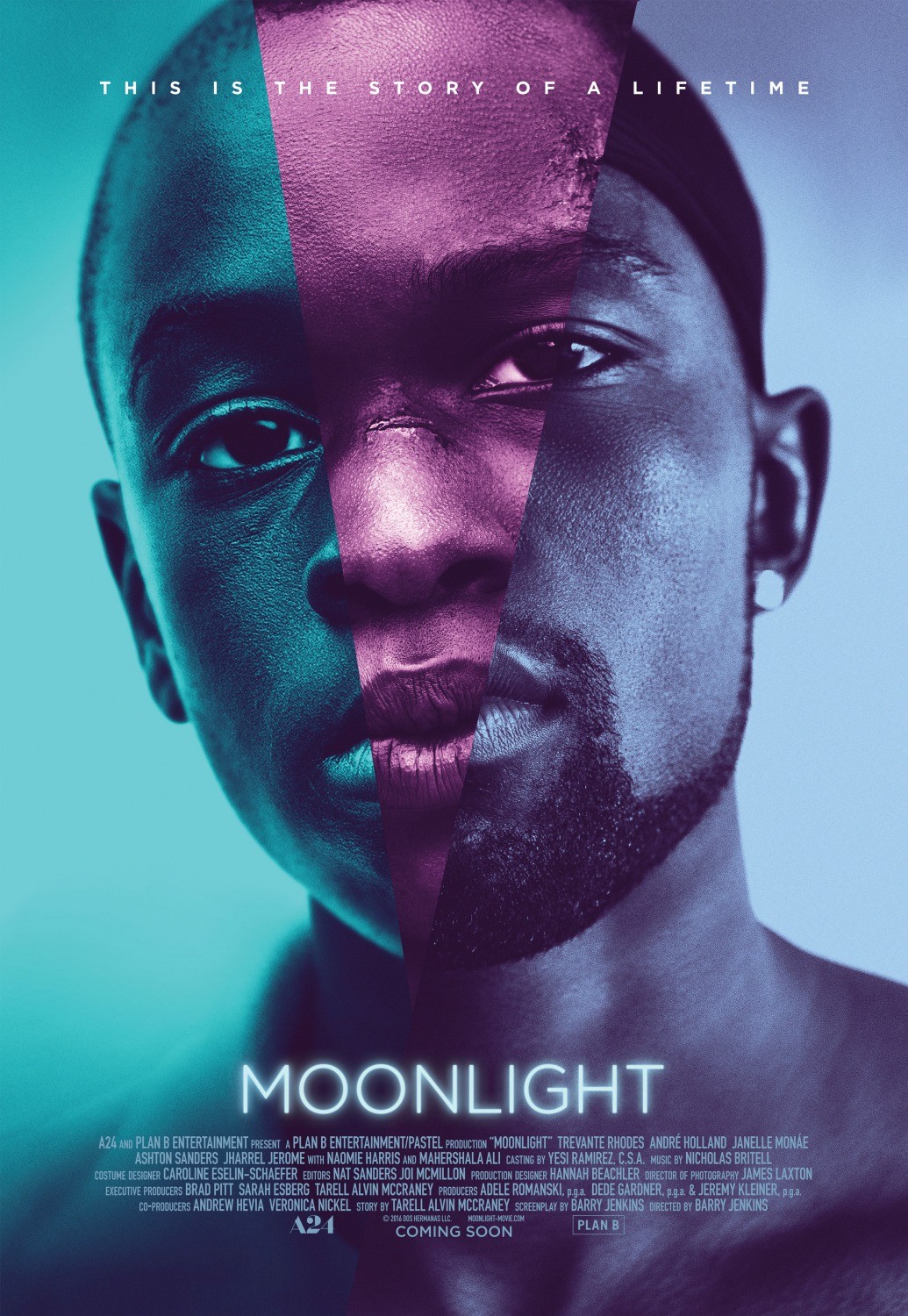
And the color palette? Forget about it. These days, it seems like too many films get by on a minimalistic, drab, gray palate. While this certainly works for some types of films, Jenkins and Laxton have chosen to bathe us in color. It’s almost as if the color is fluid or liquid, it moves like the ocean. The movie, at times, feels like a painting and does justice to its title (a shortened version of the original title, In Moonlight Black Boys Look Blue, a play by Tarell Alvin McCraney).
The story is set up in three acts that take place in different periods of the main character’s life, and all titled after an adopted “identity” of that character at that particular time. Three different actors portray “Little,” Chiron,” and “Black,” at three different times in his life (elementary school, high school, and after a stint in jail). All three performances deserve praise. The quiet reserve of these young actors is a sight to be seen. All three are soft-spoken, they don’t have much to say, but the emotion portrayed is downright palpable. Long, awkward moments of silence speak volumes.
At age nine or so, “Little” (Alex Hibbert) is bullied by the bigger kids at school. He is taken in by respected local drug dealer, Juan (Mahershala Ali, who, in my opinion, is a shoe-in for the best supporting actor Oscar), and his girlfriend Teresa (Janelle Monáe) where he finds refuge from his drug-abusing mother. Juan can see that Little needs guidance and steps in as a father figure, doing his best to fill a much-needed void in this young man’s life.

Later, we meet “Chiron,” (Ashton Sanders) which is actually the character’s given name. Now in high school, Chiron is still being bullied for being different. His mother’s (Naomie Harris, nominated for the best supporting actress Oscar) drug use is now out of control and has become a full-fledged addiction. She is extremely erratic and unstable, which often sends Chiron to Teresa’s house for refuge once again. After a pair of polar opposite encounters with his longtime friend, Kevin (Jharrel Jerome), Chiron is driven to action against his bullies.
Part three, “Black,” takes place some years later. We learn that Chiron has spent some time in prison, and has now adopted the drug dealing lifestyle of Juan, his surrogate father from childhood. Now living in Atlanta, one night he gets a late night call from Kevin (Andre Holland) back in Miami, which prompts him to make an impromptu trip back home.
This plot synopsis intentionally does nothing to get at the heart of the story. It exists as simply a way to let you know what “happens” in the film. The true heart of the story is much more intangible and universal. Identity, or lack thereof, is what is at stake here. Chiron, in each of his incarnations, is an outcast. First, he’s too young to understand that he’s different, he just knows that he is. When he’s in high school, he most certainly knows what is different about him, which makes him even more afraid and vulnerable. He’s trapped in a world that isn’t likely to accept him. That he finds solace in an old friend is comforting for a time, but ultimately proves tragic to young Chiron. His third iteration is the result of his entire life up to this point. He is, seemingly, a changed man; strong, handsome, and confident (at least outwardly). Inside, it is plain to see that he is in survival mode. He masks who and what he truly is. It’s possible that he doesn’t even know or acknowledge who he really is. He projects bravado to the world with his appearance and chosen profession, but inside, he’s still clawing for a true identity.

Chiron is a truly tragic figure. The advancements he makes towards his true identity in the third act simply magnify the fact that he is a product of his environment, and in this environment, there is no place for him. His true self cannot exist there. Since high school, he has built himself into a figure whose identity cannot be questioned, but in doing so, has prevented his true identity from ever being able to be seen. He’s trapped himself in a cage in order to survive.
This is all held together by the insanely amazing performances of the entire cast. The 20-or-so-year span of Chiron’s life is seamless in its execution. All three actors completely embody their shared character. No suspension of disbelief is necessary as the tragedy of Chiron shines heartbreakingly through these actors. Even the movie poster represents this flawlessly. If you’re not sure what I’m talking about, have another look at it.

I’m not sure I have done justice to the emotional qualities of the film. I’m not sure I can. You may have to find out for yourself, and I certainly urge you to. Moonlight is a very emotional and moving film, and although it takes place within a very specific location, and a very specific socioeconomic group that many may have trouble identifying with, its themes are truly universal. It accomplishes the rare feat in moviedom of turning clichéd character types on their heads, and through that, manages to get at some profoundly human truths with a style and grace we are rarely treated to. You may be from somewhere else completely, you may not think you could possibly identify whatsoever with the film’s content or characters. You may think those things, but I bet you’d be wrong.
After the credits had rolled and the lights came up, I overheard an elderly white woman say, “It’s real life, unfortunately.” To hear someone of that generation say something like that was telling. I believe Moonlight has the potential to build some very meaningful bridges. Film is a powerful medium, and this is one powerful film. I’m very glad I finally got to see it, and I wholeheartedly recommend it.
