
Film Review: First Reformed (2018)
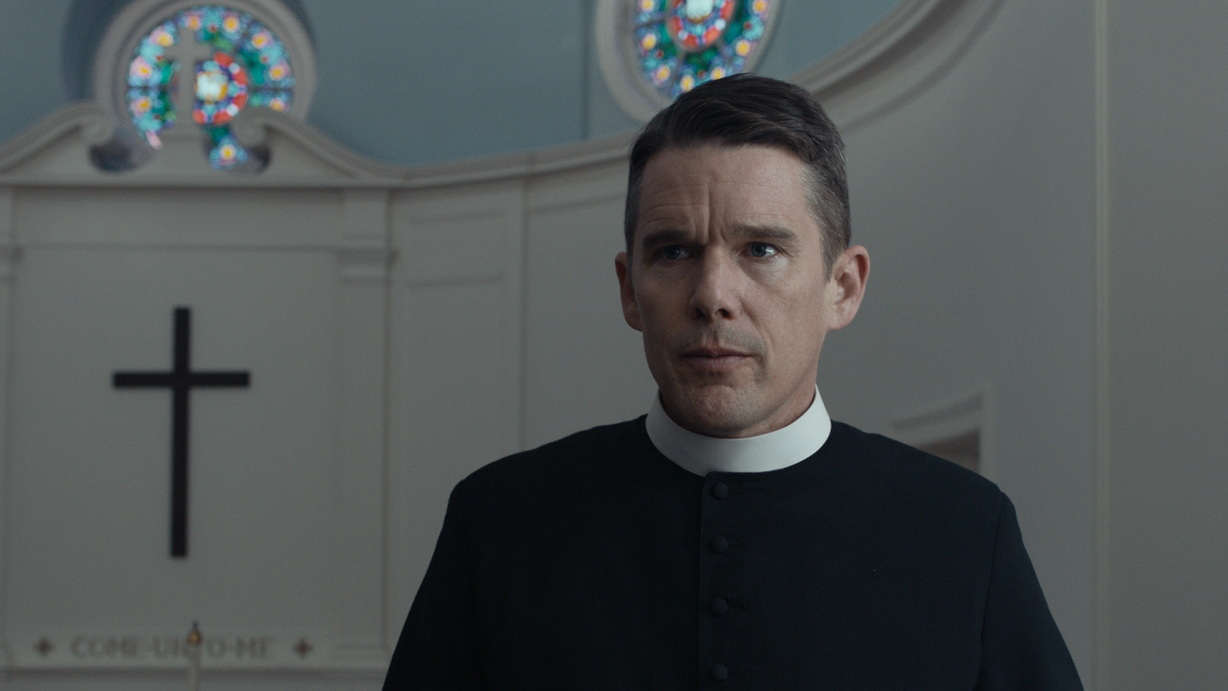
I think it goes without saying that anything that writer and director Paul Schrader touches is not going to be for everybody. He’s been doing what he does for some decades now, and I don’t get much of a sense that he gives a rat’s ass if you like what he’s got to say or not. His protagonists are almost always self-destructive, antisocial loners whose wild ideas get wilder and wilder as his films progress. First Reformed fits snuggly into this description, but to leave it at that would be doing the film and its writer/director a disservice. This is a wonderful film – one of the best of the year – but I warn you, there are moments when you won’t think so.
The plot is best left to unfold on its own, but I’ll tell you what I told a coworker. Ethan Hawke plays Ernst Toller, the reverend of a small, historical church in upstate New York. As the film opens, he begins keeping a very candid diary of his thoughts and observations. After meeting a troubled young couple who attend his services (Amanda Seyfried and Philip Ettinger, and this is where I stopped short with my coworker, who suggested I use this line verbatim in my review), a bunch of stuff happens. Not very elegant, I know, but I’ve found myself at a point where, if I continued, the urge to spill all the beans would be too strong. What unfolds is nothing short of modern cinematic mastery, and I don’t want to ruin anything.
Comparison’s to the Schrader-penned Taxi Driver (1976) are inevitable but would do a disservice to First Reformed. Reverend Toller and Travis Bickle may snack from the same tree of misanthropy, but they are very different men – and these are very different films. Where Bickle is clearly unhinged, Toller is collected and coherent. Scorsese’s depiction of the gritty New York underbelly is replaced by Schraders’ serene, small-town calm. Don’t let this calm fool you, though. There’s a darkness simmering below the surface that comes to a boil so naturally, you may not even notice you’ve been taken in by it. By the time it’s revealed in full, the cathartic release is, for me, a completely satisfying shock. For others, it may just piss you off.
Schrader accomplishes much of his tension through clever lens choices, character blocking, and the career-defining performance of Ethan Hawke. Imagine a confessional booth. The two parties sit with bodies faced forward, but heads turned to the side. Then, they simply speak to each other. No one is ever actually in a confessional booth (it’s a Protestant church), but the religious implication of the conversational set-up is unmistakable. Schrader’s lenses distort their features and the cameras box them in. There’s a sense of claustrophobia at work, but not in a jail cell kind of way. It’s as if once you’ve started down the path of speaking your mind, you’re trapped until you finish. Whatever it is, it’s a neat trick and a bold choice that enhances the mood of the film and serves the tone well. Hawke’s near-deadpan delivery while expounding universal truths the likes of which Travis Bickle never approached tops the whole thing off. His logical and reasoned words draw you in until you’re a co-conspirator.
There are moments of pure spirituality that may confuse or offend some. At one point, First Reformed takes off into what seems at first a Tarkovsky inspired realm, then moves right into a Kubrickian acid flashback. It’s a startling event, much like the climax of the film, that’s likely to leave many scratching their heads. In my notes, I wrote, “This might be out of place, but it might be perfect.” It’s a polarizing scene without a doubt, but I’m going with the latter in that statement. As for the final shots of the film, I remarked to a trusted friend and fellow fan, “For a moment I thought ‘That’s the end? What the f*ck!’ Which quickly gave way to ‘Schrader you magnificent bastard!’”
Yes, Paul Schrader, you are a magnificent bastard. And this is one magnificent film.

