
Film Review: The Maltese Falcon (1941)
MacGuffin
Mac·Guf·fin
/məˈɡəfin/
noun BRITISH
a plot device in the form of some goal, desired object, or another motivator that the protagonist pursues, often with little or no narrative explanation. The MacGuffin’s importance to the plot is not the object itself, but rather its effect on the characters and their motivations.
Has there ever been a more tried and true plot device than the MacGuffin? I’ll spare you the history of the term other than to say that its use stretches from medieval tales of Arthur’s Holy Grail to Marcellus Wallace’s briefcase in Pulp Fiction. To put it simply, it’s an object that everyone wants—and it doesn’t matter in the slightest what it is or what it does. Characters, good and bad, fight over it. They lie, murder, backstab and double-cross to get it. They form uneasy partnerships that end badly for almost everyone, even the true of heart. Alfred Hitchcock is credited with popularizing the term in the 1930s and was perhaps its greatest practitioner, but in 1941 he got a run for his money. In John Huston’s film (based on Dashiell Hammett’s 1930 novel), the MacGuffin is a jewel-encrusted bird known simply as “The Maltese Falcon”—and cold hearts and hot hands alike will stop at nothing to possess it.
The four parties after this rare and valuable statuette are so used to duplicity they hardly get upset when they themselves are the victim of it. It’s all part of the game—no sense getting upset, just pick up your pieces and keep playing. The trickery is constant, with one side playing the other, off the other, off the other, right up until the very end.
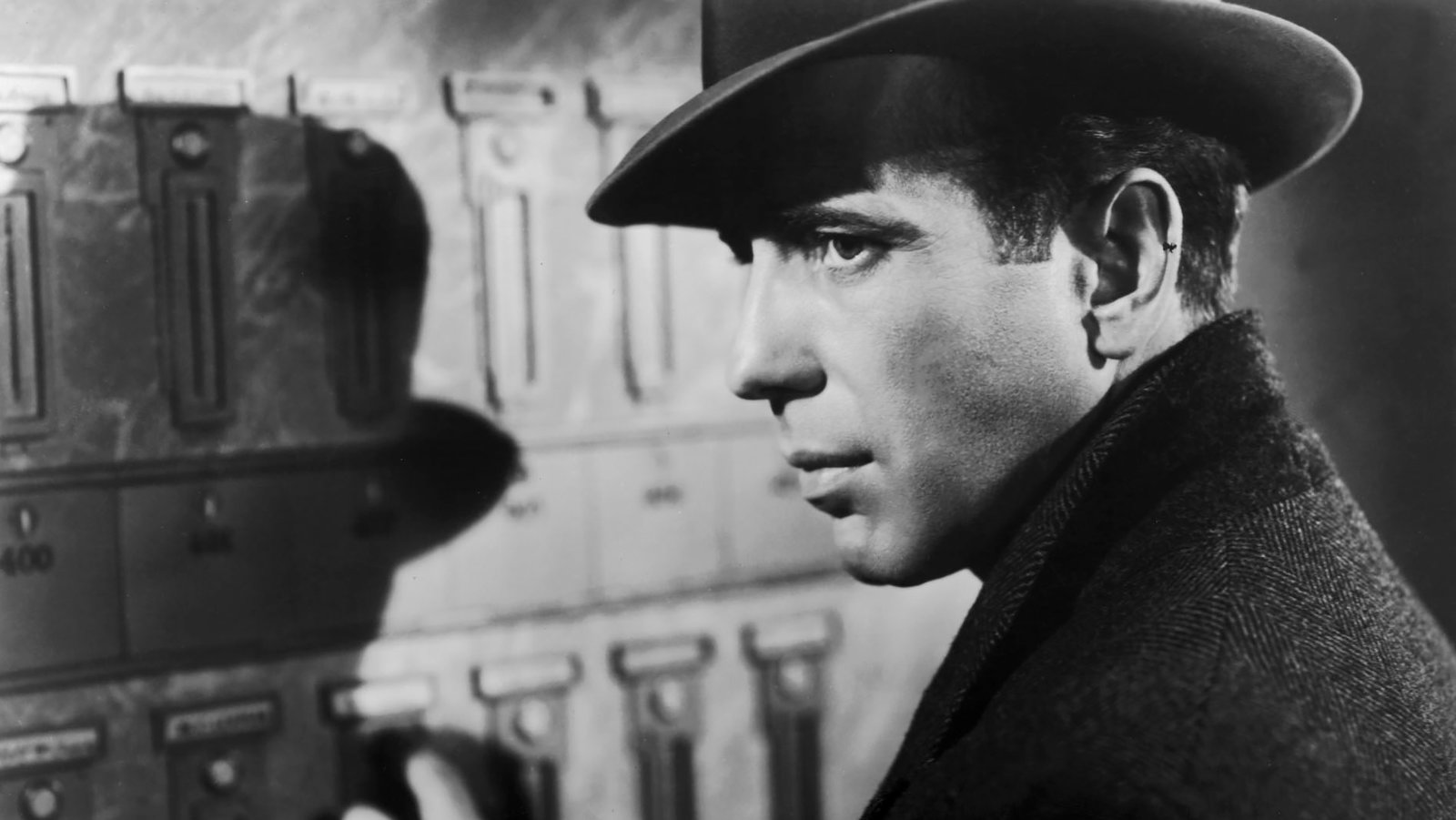
The Maltese Falcon is more than a good movie—some call it the first Film Noir. On a formal level, it doesn’t share a lot with what the genre would come to be known for in the coming years (stark contrast, angular shadows, etc.), but thematically, we’re talking textbook Noir at its finest. There isn’t an honest or decent character in the whole movie. Even the so-called protagonist—hard-boiled, hard-drinking, and hard talking Sam Spade (Humphrey Bogart, in a career-changing role)—is just a hair shy of miscreant. He wears his cynicism fashionably on his sleeve and gleefully shows it off whenever possible. Bogart’s role and portrayal is the archetype for just about every private eye to hit the screen for decades to come.
Sam Spade is cold-blooded, possibly more so than the criminals he consorts with. He’s a man of action, but of words too. He’s capable of talking himself out of jams with the police, and of throwing punches with gun-toting hoods. He’s smart, but when love is on the line, he’s even smarter—and possibly at his coldest. Listen to him cleverly get around the Haye’s Code censors with half-hidden insults and allusions to his rival’s masculinity (in a modern movie, he’d likely be the villain). This tough demeanor is quintessentially Noir, and it’s been reworked, retooled, mimicked, ripped off, and straight-up copied time and time again in the last seventy-five years — some with success, some without, but Sam Spade and Humphrey Bogart are originals.
The rest of the cast is one of the finest ever assembled. With only four main players (five if you count Elisha Cook Jr’s Wilmer—poor, poor Wilmer), they’d all better be good. First, Mary Astor’s Brigid (or is it Ruth?) is delightfully deceptive. Spade may know telling the truth isn’t her strong suit, but he’ll be damned if he’s not impressed by her guile. Even she may not know the truth anymore. Then, the ultimate pair: Sydney Greenstreet and Peter Lorre. If a more villainous and enjoyable duo as Kaspar Gutman and Joel Cairo has ever been captured on film, I’d like to know what it is. Greenstreet, who was a 61-year-old stage veteran, made his film debut in The Maltese Falcon. His presence is undeniable, with his performance to become the model for rich, thrill-seeking underworld figures who’ll stop at nothing to get what they want. Lorre had already made a name for himself by 1941, but really turned it on and relished in his role as Cairo. These two, along with Bogart, would star in another little movie a few years later called Casablanca.
The Maltese Falcon was Sydney Greenstreet’s screen debut, but it was John Huston’s directorial debut. After years of bit parts and screenwriting, he’d convinced Warner Brothers to give him a shot at directing. They agreed but were apprehensive (the Hammett’s story had been filmed twice before, with both attempts being failures). When he came in ahead of schedule and under budget, they were naturally pleased, but still didn’t promote the film—until it became a hit that is. Huston would go on to direct Bogart and many others in a string of hits through a career that would last decades. His work, like The Maltese Falcon, has a lean, efficient, and sturdy quality to it. He’s been called the Ernest Hemingway of cinema (artistically, physically, and characteristically). An apt description.
Huston and cinematographer Arthur Edeson may have kept the film out of the literal shadows (unlike the Noirs to come), but they did utilize odd angles and interesting camera movements to help tell their story (along with Bogart’s Spade, another precursor to the genre). Watch as the camera moves around Greenstreet, and how it sits low to the ground. It’s angled up so that you can see the ceiling above, skewing the frame and denoting treachery. Symbolism and foreshadowing are everywhere. Keep your eyes peeled.
The MacGuffin—the actual item—is basically meaningless. It’s a device to help us understand how the involved parties interact, who they are, and the depths they’ll plunge to get what they want. The ending may surprise you (or not, depending on your level of fatalism). Two characters walk away unscathed (but for how long?), one might be on their way to the death house, and one carries on just as miserable as before. Does anyone learn anything? Probably not. Each is who they are, and that can’t be changed. In true Noir fashion, the cruelty and criminality exist already in our players, they just need something or someone to bring it out of them.

