
Film Review: Sirât
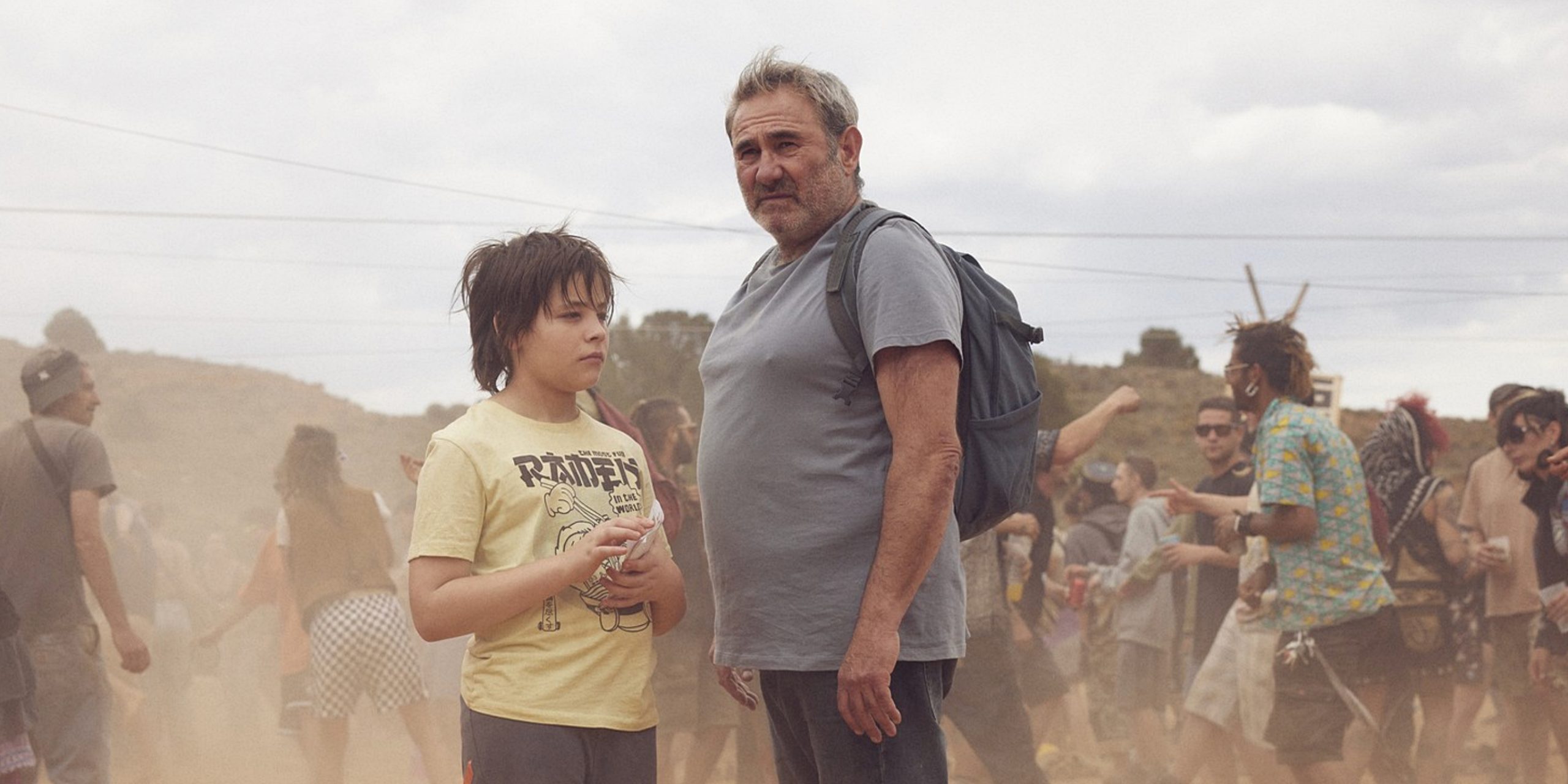
Of all the movies I saw in 2025, Óliver Laxe’s Sirât (an Islamic term for the narrow bridge between Heaven and Hell) is easily the most difficult and uncomfortable to watch. Calling this doomed journey grim would be putting it lightly, but beneath the mental and physical torture he puts his characters through, Laxe strikes a balance between terrifying existentialism and the kinds of deep truths we all know but rarely speak aloud. It may be hard to spot, but there is meaning to be found in the dust-choked and sun-beaten hell of Sirât. The only problem is that finding may require a level of fortitude many filmgoers are unwilling or unable to tap into.
The film opens as Luis and his young son Esteban (Sergi López and Bruno Núñez Arjona) awkwardly meander around a giant outdoor rave in the deserts of Morocco. To say they look out of place among the scantily clad and drugged out dancers is an understatement, but their presence is well intended: Luis’s daughter, Esteban’s sister, is missing, and they heard a rumor she may be attending the traveling party.
They don’t find her, but they do befriend a group of vagabond ravers (Richard Bellamy, Stefania Gadda, Joshua Liam Henderson, Tonin Janvier, and Jade Oukid) who seem to think she looks familiar. They tell Luis there is another rave happening soon further into the desert that they should check out. From there, Luis and Esteban (and their dog Pipa) set off with this ragtag group of anarchist misfits into the desert in search of answers. Needless to say, things do not go well.
Lurking in the background of this ill-fated passage across the dried and cracked no-man’s-land are radio and television broadcasts heralding increasing tensions between unnamed nations. The implication is that some kind of armageddon event is imminent, and that all the world, including Morocco will be affected (the presence of soldiers at the rave backs this up). These half-heard apocalyptic tidbits scattered throughout the film create a frightening sense of fatalism that not only never lets up, but grows exponentially as the film progresses.
As the damned caravan delves deeper and deeper into the unknown Luis, Esteban, and the ravers grow closer. They each have things to teach one another, and for a time, the camaraderie and sense of found family grows. But, before long, the hell they are in (and, by extension, the hell the whole world is in) shows its face in progressively tragic and brutal ways through a series of shocking and upsetting events. Through these events, you may be tempted to dismiss Sirât as unnecessarily cruel (as I nearly did), but I promise you this is not the case. Laxe is telling us something about the world we live in – or more accurately, about what the world has in store for us if we can’t find a way to fundamentally change how we treat each other.
To achieve this grim examination of fate and global trajectory, Laxe borrows liberally (both visually and thematically) from Henri-Georges Clouzot’s landmark 1953 film The Wages of Fear – one of the most tensely riveting films I have ever seen. But I also see heavy doses of another existential journey into the desert: Monte Hellman’s criminally underseen 1966 Western The Shooting, starring Warren Oates, Will Hutchins, Millie Perkins, and a sneering young Jack Nicholson. Where Clouzot’s film offers continual nervous energy and ends tragically after the ego of its surviving protagonist gets the best of him, Hellman’s is a subtly shocking descent into desperation with one of the greatest final shots of all time. Both of these films lend heavily to Sirât, but I’ll leave it up to you which is the bigger influence.
