Film Review: No Other Choice (2025)
Six years ago, if you can recall those pre-COVID halcyon days of yore, South Korean director Bong Joon Ho’s Parasite took the world (and the Oscars) by storm. At the time, I thought this densely layered and darkly comedic critique of capitalism might prove to be the wake-up call so many slumbering Americans needed – a loudly ringing alarm clock that would not only open their eyes to their own exploitation, but also make them see that, despite their land of origin, the predatory claws of unregulated free enterprise have us all in a bloody, vice-like grip.
Despite all best intentions and efforts, Parasite failed to spark a national renaissance of critical thought and debate about the value of labor and the natures of excess and poverty, but I do believe it helped push those who bothered to see it in the right direction. After all, how could anyone with a thinking person’s brain in their head and a modicum of decency not recognize themselves when applying the world of Parasite to their own lives?
Even so, as the world continues to burn around us, and as working class grievances continue to pile up with each new daily atrocity, my dreams of Americans revering the likes of Big Bill Haywood and Emma Goldman over athletes, actors, and oligarchs are one step closer to fruition. What the final spark will be that ignites true class consciousness I can only speculate, but I have no doubt that well-reasoned, deliberately pointed, and aptly satirical art will play a major role. With this in mind, and perhaps unsurprisingly, the latest cinematic salvo in our eternal battle for hearts and minds has once again come violently screaming at us from none other than South Korea.
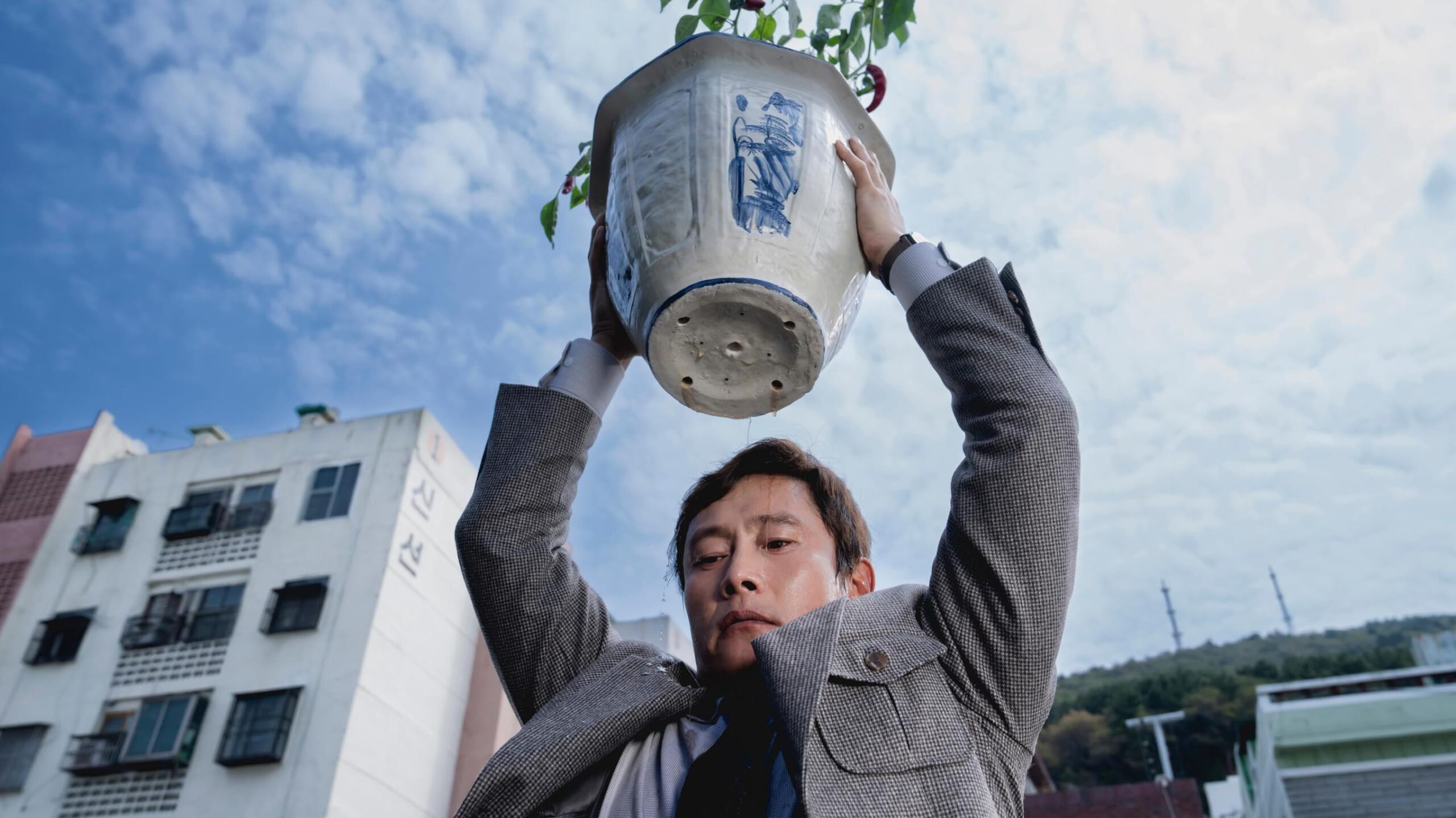
Like Bong Joon Ho, Korean director Park Chan-wook is no stranger to probing political commentary told through a lens of gruesomely realized character choices – and Park’s latest, No Other Choice, is no different in this regard. In Parasite, Bong has his protagonists (a down-and-out yet hard-working family in need of a break) infiltrate a rich family’s confidence only to have everything blow up in their faces in the most violent ways possible. In No Other Choice, Park takes a similarly macabre approach, but turns it on its head by having his protagonist Yoo Man-su (a well-meaning paper mill employee played with perfectly-timed comedic bumbling by Lee Byung-hun) start the film in above-average economic and social comfort, only to have it threatened by downsizing and multinational corporate acquisitions.
After losing his cushy job, Man-su finds himself adrift as he scrambles to pay the mortgage on his spacious home and keep his wife Mi-ri (Son Ye-jin, who, in my opinion, should be in the running for the Best Supporting Actress Oscar) and his children Si-one and Ri-one (Kim Woo Seung and Choi So Yul) happy, comfortable, and as in the dark as possible. To this end, Man-su slowly strikes upon a plan and puts it into motion: he will murder his competition, making him the only viable candidate for employment in his field. And believe it or not, comedy ensues.
Yes it’s dark, but it’s also keenly aware of its darkness, which leaves plenty of wide open space to be filled with social and cultural commentary. As Man-su begins to execute his scheme, everything naturally goes wrong in increasingly comedically interesting ways, but his brash behavior and gumption mutate along the same lines. What seemed unthinkable at the start seems passé by the end, leaving the big question: was Man-su always capable of murder or did societal and economic pressure alone push him toward his heinous acts? And if it’s the latter, then surely even the most densely conservative among us can see that the same must be true for the poor, underprivileged, and marginalized everywhere.
But No Other Choice isn’t just a commentary. It’s also a profound artistic achievement. Along with cinematographer Kim Woo-hyung, Park has created one of the most visually stunning films to come along in some years. The pair’s use of innovative techniques and tilting cameras that morph into match cuts would make Kubrick and Lean spin in their graves with jealousy if such a thing were possible. Even if pitch black social commentary isn’t your thing, No Other Choice is still an astounding watch based on its visual style alone – and that it was completely snubbed by the Oscars should be considered a major scandal. My only explanation in this regard is that Hollywood doesn’t want any more Parasites exposing its shortcomings on the world stage. They are a largely self-congratulatory and cowardly bunch, after all. Shutting out No Other Choice may have been an act of self defense.

