
Film Review: The Night of the Hunter (1955)
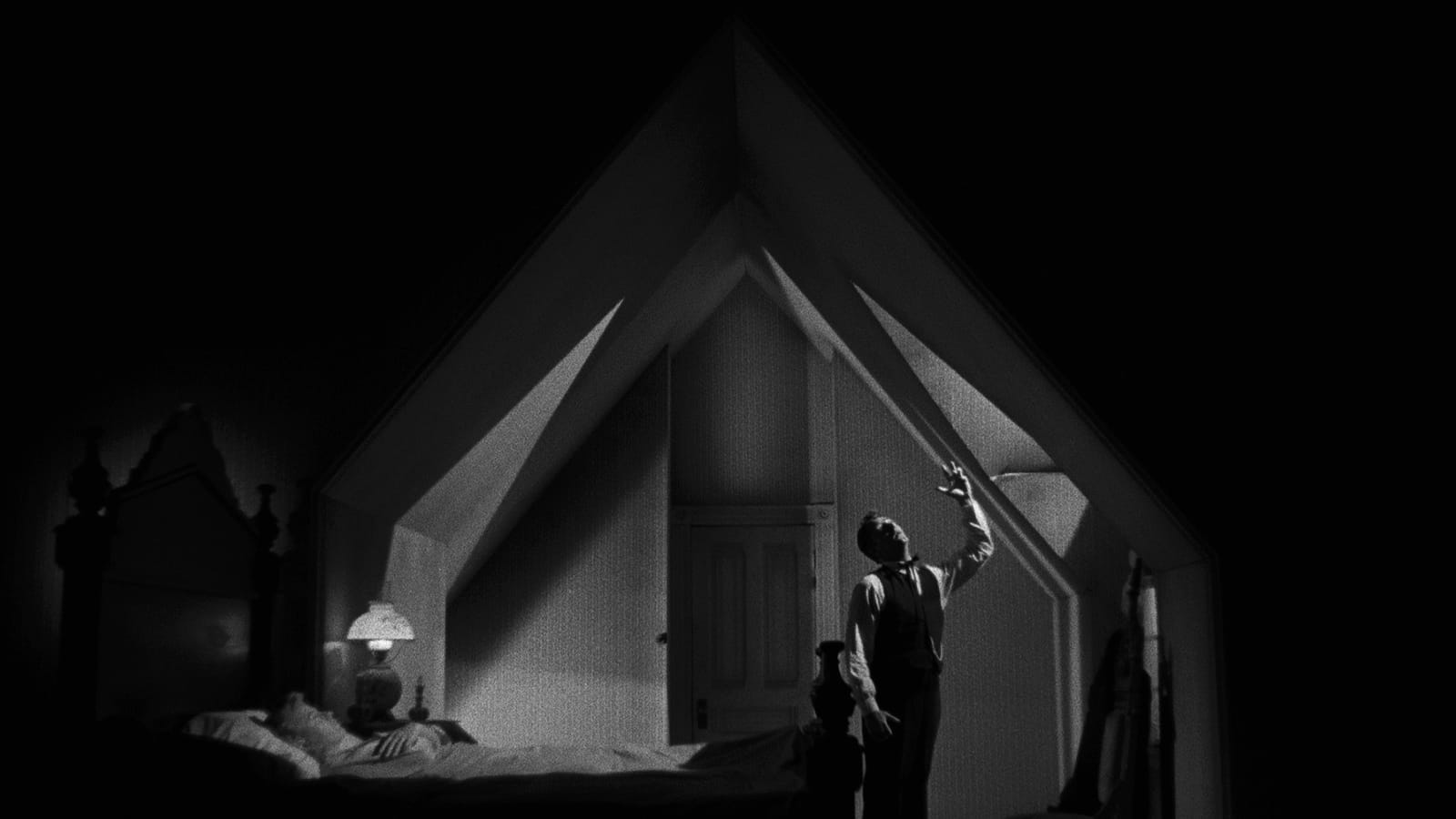
What a weird, scary, and wonderful film The Night of the Hunter is. It’s director, Charles Laughton—who is much better known for his stage and screen work in front of the camera—made only this one film. It would have been interesting to see what else he might have been capable of, but alas, it was not to be. His only directorial effort was panned by critics and a failure at the box office. Sometimes greatness has to stew for a while before it can be recognized as such. Laughton’s surreal dreamlike settings, mixed with an utterly wicked and amazing villain, combine to form one of cinema’s most unforgettable films. Robert Mitchum’s sly and sinister Reverend Harry Powell may not have been the first movie villain, but he’s certainly one of the best, and most influential.
It’s a weird move, there’s no getting around it. The set pieces look fake, and the whole thing has the air of a dream sequence. Exactly what it is can be hard to pin down. Is it a film noir? The sharp angles, clever use of shadow, and an all-around feeling of foreboding might certainly suggest so, but I wouldn’t call it that exactly. Horror, perhaps? Maybe, but that’s not quite accurate either, even though it is quite scary. This lack of definable genre likely contributed to the cold reception it received back in 1955, but I find it to be a plus. It makes for quite a wild ride.
Mitchum plays Henry Powell, a self-proclaimed “Reverend” who travels the countryside killing women he deems as impure, or otherwise deserving of death. He then steals their money, claiming that it’s God’s way of financing his preaching of the word. He’s fond of his switchblade knife, which he carries in his pocket. The knife has a funny way of cutting through his clothing whenever he sees a woman acting in an arousing way. It juts out violently from his pocket. Powell has the words “LOVE” and “HATE” tattooed across his knuckles, which he uses to describe the epic struggle between good and evil to anyone who will listen. Henry Powell is one of the most vicious and evil characters ever set to film.
After winding up in jail on a thirty-day stint, Powell’s condemned cellmate (Peter Graves) tells him that there’s $10,000 hidden at his farm back home. Upon his release, the Reverend quickly makes for the farm, seduces the widow, Willa (a stellar Shelley Winters), enthralls the townsfolk, and sets out to find the money. Only the children, John and Pearl (Billy Chapin and Sally Jane Bruce), know that it’s hidden in young Pearl’s dolly. Thus, the cat and mouse game begins.
Powell may have his mother, sister, and the entire town fooled, but John isn’t buying it. He sees right through the conman masquerading as his new father. When Willa eventually becomes wise to him, he quickly dispatches her in a nightmarishly wonderful scene, only to be followed by a tragically beautiful underwater shot of her at the bottom of the river. It’s an amazing juxtaposition—the sharp angles of the murder, and the flowing serenity of its aftermath.
Eventually, the children flee on a Moses-like trip down the river. Images of animals are seen watching them as they float along—rabbits, for example, possibly representing their childlike innocence, and spiders, not so subtly showing them trapped in a giant web. All the while, Powell pursues on horseback, his figure being seen in shadow on the horizon. He whistles and sings as he stalks his prey.
Stylistically, the film is all over the place, almost goofy at times. As I’ve said, Laughton seemed to have trouble deciding what sort of picture he was making. It all comes together, however, the wackiness enhancing the experience. Had this film been made any differently, however, it would not have had nearly the same effect. It may be off, but it’s still perfect.
Formal weirdness aside, the subtext of the film deals specifically with sex. Depending on your own stance on the subject, the film could easily be seen as progressive or conservative (which characters you identify with may say a lot about your personality). Personally, I see it as almost a feminist piece—with women openly stating their feelings on the taboo topic (for the 1950s, it’s surprisingly frank).
Powell is both repulsed and turned on by what he views as sinful women (killing them somehow absolves him of his own lust), with his switchblade clearly representing the sexual violence men are capable of. Meanwhile, Willa is conditioned by Powell to reject her own femininity and embrace his skewed vision of it, thus becoming a slave of sorts. Willa’s employer, Icey Spoon (Evelyn Varden), has much to say on the subject (much to her husband’s chagrin), as does Rachel (Lillian Gish), who sees men as nothing but trouble for young women.
Laughton’s portrayal of the men in the film isn’t very sympathetic (they’re murderous, single-minded, weak, selfish and/or stupid). Something rather refreshing for 1955, I’d say, but perhaps another reason it was originally panned.
Mitchum’s cool psychopath portrayal can be seen in every villain from Hopkins’ Hannibal Lecter to Hopper’s Frank Booth. He was truly ahead of his time, and the perfect Hollywood outsider for the job (read up on some of Mitchum’s exploits, especially his marijuana bust, it’s interesting stuff). If it’s gritty realism you’re after, you may want to look elsewhere. But, if it’s captivating storytelling with an air of oddity and menace, then look no further.

