
Film Review: Rear Window (1954)


In the hands of a different director (even a very good one), a film that takes place entirely within a small apartment would likely be one rife with claustrophobia. I can imagine that being the intention, in fact. A man has broken his leg – or something similar – and while laid up begins to go mad with boredom and loneliness. Perhaps he starts to see things or hear things. Maybe the itching becomes unbearable due to the millions of tiny bugs crawling around in his cast. A knife or other object may be taken to the infernal thing. Paranoia inevitably creeps in, causing bursts of violence… This is all quite well and good for another movie, but that’s not at all what we get with Rear Window. The claustrophobia I mentioned is nowhere to be found, even though we never leave the apartment. There’s a whole world to be explored through the windows of neighbors, and it’s a big one.

There is no other director who could have pulled this film off. I’ve seen them try, and I’ve seen them fail. The journey that Alfred Hitchcock takes us on is total. We willingly become co-conspirators, gleefully poking our noses in the affairs of others. There’s a sense of guilt that comes with this voyeurism – or at least there should be – but as the plot unfolds, this guilt erodes into a sense of duty. We simply must know the truth. Hitchcock hooks us quite carefully – so carefully that we’re not even aware we’ve been hooked. We’re never shown a crime, and we’re not exactly told we’ve seen one either. The pieces are all there, but it takes time to put them together. Consideration is needed to absorb what we may or may not have seen.

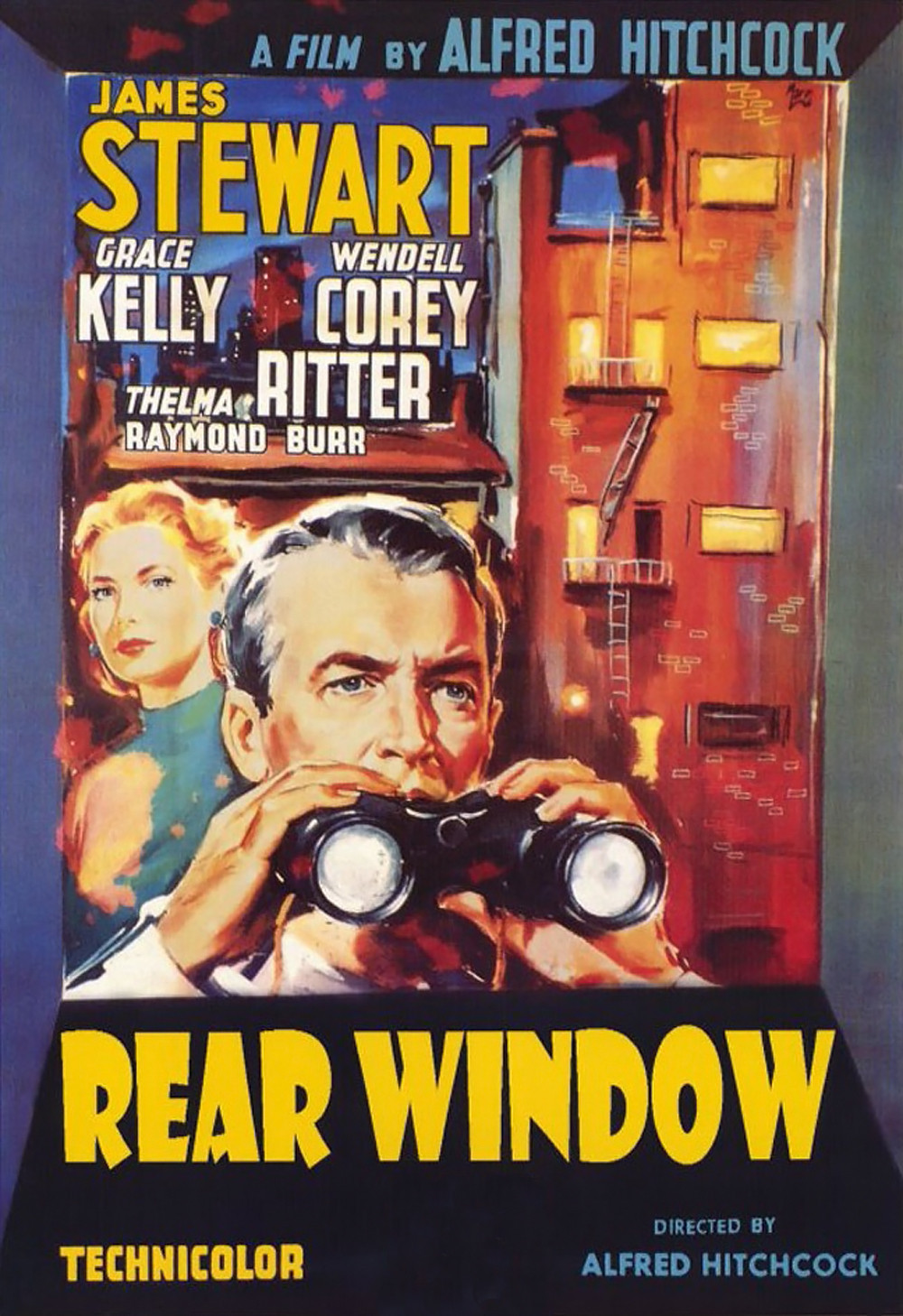
Hitchcock unfolds his story (written by frequent collaborator John Michael Hayes and based on the short story by Cornell Woolrich) with expert pacing. Photojournalist Jeff Jeffries (James Stewart) is held up in his apartment with a broken leg. To pass the time, he spies on his neighbors through binoculars. He’s discovered a community full of colorful characters and personalities. He gives them all nicknames like “Miss Torso,” and “Miss Lonelyhearts. He’s gotten to know them, in a way, even though he’s never met any of them.” Jeff is visited daily by his nurse (Thelma Ritter), and his socialite girlfriend, Lisa (an astounding Grace Kelly). I’ll let the rest of the plot unfold naturally, but in short, Jeff believes a crime has been committed in an apartment across the way and grows increasingly obsessed with solving it.

Here’s the thing though. In a different movie (i.e. lesser attempts at similar stories) no one would believe Jeff. They’d call him paranoid and tell him to quit spying before he gets himself in trouble. But that’s not how Hitchcock operates. It so happens that nearly everyone believes him and is willing to help in some capacity. The allies he gains are easily convinced, and, like us, become willing participants in solving the crime. He’s most surprised by his girlfriend Lisa, who proves to be anything but the stuffy Madison Avenue type he thinks she is. Watch as Jeff’s attitude toward her changes in the blink of an eye when she defies all expectations. It’s funny that it takes her violating the law on his behalf for him to see who she really is. Men sure are stupid sometimes.

James Stewart may have top billing, but Grace Kelly steals the show. She is nothing short of spectacular as Lisa, Jeff’s upper-class love interest with a few surprises up her sleeve. There are other scene-stealers as well. Raymond Burr as Thorwald is deadpan and menacing but manages to keep us guessing until the very end. When he finally meets Jeff face to face, his features are clear for the first time. He’s an animal backed into a corner – terrified and dangerous. And let’s not forget Ritter as Jeff’s nurse, Stella. She cracks wise about fortune tellers, but she may be one herself. Then there are the neighbors. None have much to say to us – we can see them speak, but rarely hear them – but each becomes familiar. Through them, we get the lay of the land and a glimpse at the machinery that makes the block run.

Rear Window is more than a masterpiece. It’s groundbreaking cinema. Tension builds with almost no sound, with only glimpses of action and hints of suspicion to drive us along. There are so many areas where the film could have derailed, but of course, it never does. It keeps right on track, building steam right up until the thrilling climax. It goes without saying that Hitchcock is a master, but Rear Window may be his pièce de résistance. With a filmography as stacked as his, that’s saying something.
