
Film Review: Black Panther (2018)
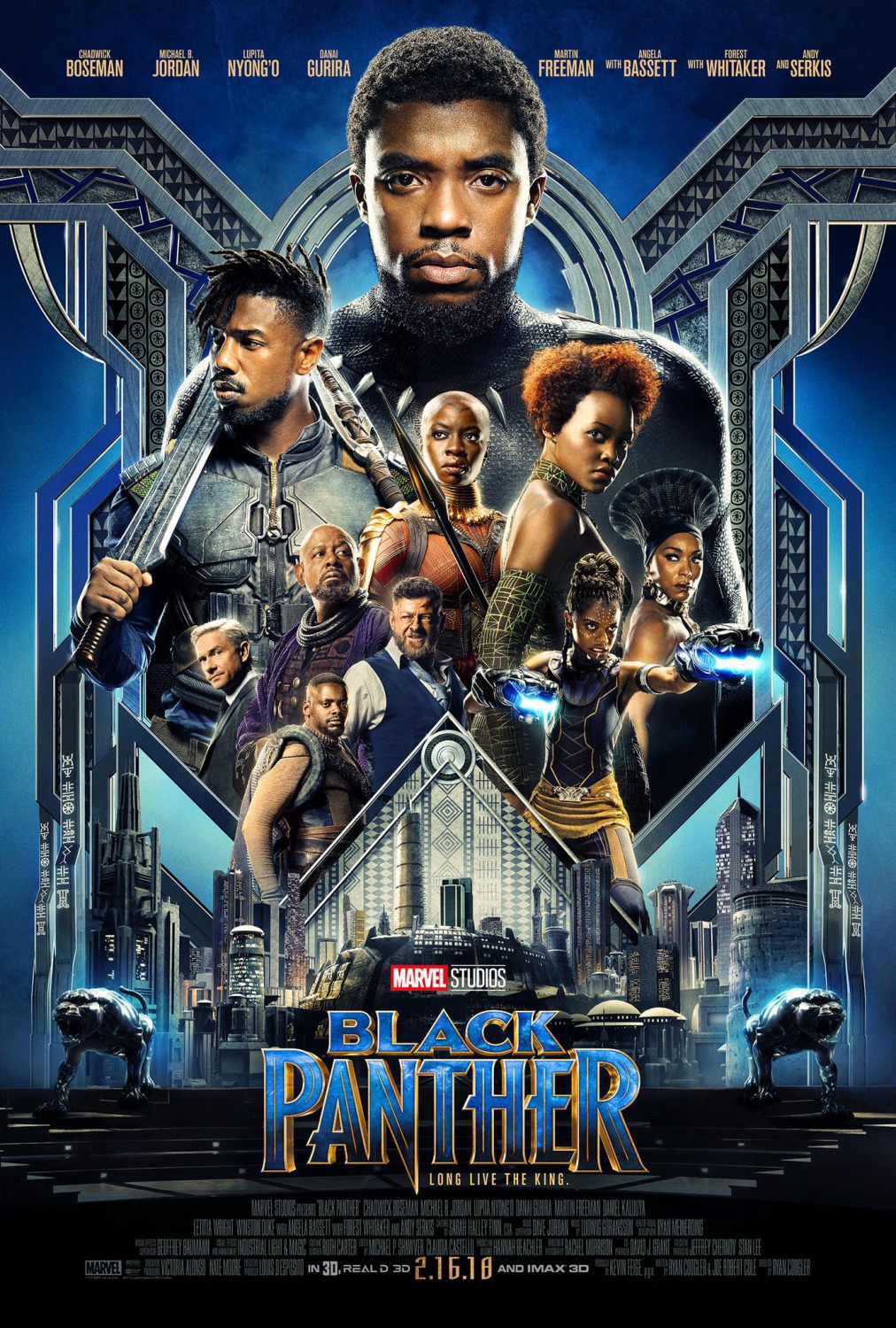


While Stan Lee (creator of the Black Panther comic book character, along with co-creator Jack Kirby) may deny any intentional affiliation with the famous Oakland-based radical organization, The Black Panther Party, the film of the same name fully embraces it. Ryan Coogler and his team have made one hell of a movie about social change, and that it’s a comic book movie should really tell you something about the state of activism in Hollywood. Screw elitist high intellectualism and after-the-fact white guilt posturing. You’re late to the party and ineffectual. The world needs a hero, and not one wrapped up in the American flag. Real heroes fight real enemies and effect real change. Black Panther has arrived.

Director Ryan Coogler and co-writer Joe Robert Cole crammed a lot of things into their movie. Interestingly, though, it doesn’t play that way. It was only in hindsight that I realized how much I had just seen in a short amount of time. In a lesser movie, this might be a death sentence, but in Coogler’s capable hands, it was nothing short of thrilling. What we get is a hero’s back story, a villain’s backstory, a completely realized world, mythology, and a myriad of ideas as to how humankind can better itself. Usually, it takes several movies to accomplish one or two of these things. Coogler effectively did it in one.

First, the cast. It doesn’t get much better than this. From top to bottom it’s just right. Chadwick Boseman as T’Challa/Black Panther is the most well-rounded hero on the Marvel Cinematic Universe (MCU). Superheroes are often one-note characters, defined by a single attribute such as speed, rage, or witty one-liners. Not this time. Boseman brings a humanity to his character that’s isn’t seen every day, and it’s such a relief. But he’s just the tip of the iceberg. Lupita Nyong’o (Nakia), Letitia Wright (Shuri), and Danai Gurira (Okoye) are so brilliant in their roles, they are without a doubt the best written and best-portrayed women in any superhero movie ever. Seriously, ever. They have depth, they have power, and they are real, even though they exist in a completely made up world. How about that.

The rest of the supporting cast all hist their marks as well, and help to bring this beautiful world to life. Heavy hitters like Forest Whitaker and Angela Bassett are on hand, as well as younger talents like Daniel Kaluuya and Winston Duke. Martin Freeman and Andy Serkis round out the stellar cast as a CIA agent and a crazy music obsessed arms dealer respectively.

But, it’s Michael B. Jordan as “Killmonger” who steals the whole show. Jordan brings an air of sympathy and understanding to the villain that is unique. Usually, as with heroes, villains are one-note. They’ve been wronged, the world doesn’t understand them, they’re just an asshole, you name it, there’s your villain, end of story. Killmonger is interesting because his character does, in fact, hit those notes, but he hits them in a way that makes it easy for anyone to think “Hmmm, he might be right. I don’t agree with his tactics, but he’s onto something.” It’s almost as if you want him to succeed, just not quite in the way he has planned. It’s hard to get behind his brutality, but easy to understand the thinking that led to it. Villains aren’t supposed to generate this level of sympathy, and that a character named Killmonger can get any at all is quite a feat.

There have been plenty of movies over the last hundred years or so that deal with race. I’m sure you could think of ten right off the top of your head. For me, these films have always held my interest. As a young white suburban activist punk rocker (not so young anymore) I was drawn to them as a source of knowledge. I was thirsty for the stuff—I wanted to know all I could so that I could better aid in the struggle. That may sound naive, but there it is. Many of these films were dated and inaccurate—perhaps because they were made by uninformed white people—but they still managed to get this youngster started on his way. I’m not faulting anyone for trying, but it’s very easy for inauthenticity to sneak into a well-intentioned film. This is not the case with Black Panther. As a social critique it’s as compelling as any that have come before it—perhaps more so due to its downright coolness and fresh approach. The issues it tackles are a longstanding problem in the film industry and in society, but with some determination (and box office receipts), I’m confident change is on the way.

Black Panther doesn’t have to work hard to draw attention to its underlying social issues, they’re simply there, as they are in life. They exist, and with a minimal amount of effort and compassion, these problems readily present themselves. The film asks big questions about how best to handle the kinds of changes the world so desperately needs, but isn’t in your face about it. It wants you to think right along with its characters—to make choices. It’s not a preachy film and it doesn’t cast blame (although it does get in a few choice jabs—like when Shuri calls Ross “colonizer,” I laughed out loud), but it has a lot to say simply by the nature of its existence. Can a movie effect the kind of social change so many of us are after? I believe every little bit helps, and I hope to see Black Panther kick a lot of ass for a good long while.
